classGettingstarted
Extends from Modelica.Icons.Information.
Information
What you can do with this library
The Modelica HVACAgentBasedControl presents a set of agents which can control building energy systems and systems of similar characteristics (e.g. district heating networks or electrical smart-grids). It offers a plug&play solution to control systems with multiple energy suppliers. With the help of a market-based communication mechanism and cost functions for each energy supplier, the most cost effective supplier in the system is always chosen. With the help of individual cost functions the "costs" that should be minimized can be defined individually by the developer (e.g. money, primary energy, exergy destruction).
How you set up your system with agent-based control
If you want to control a building energy system with multiple heat/cold suppliers and multiple heat/cold consumers here is how you set up the system:
- Equip each thermal zone with a RoomAgent just by placing an agent close to the zone in your model. The input of the room agent needs to be connected to a temperature sensor of the thermal zone
- Equip each heat/cold supplier with a Heat/ColdProducerAgent and a corresponding CostFunction. Make sure that the heat supplier is able to use the demanded capacity from the "setCapacity" output of the agent.
- Place a MessageNotification and a Broker anywhere in the model.
- Give each agent an individual five-digit number in the parameters under "name"(e.g. 1000X for the consumers, 20001 for the broker, 3000X for the producers)
- Write down all names of the ProducerAgents in the "startTable" of the broker. Delete or add more lines if necessary.
The system is now ready to go.
If you used older versions of this library, please add a MessageNotification agent to your agent-based systems in order to make them work. For more information please refer to MessageNotification model.
What can a building energy system with agent-based control look like?
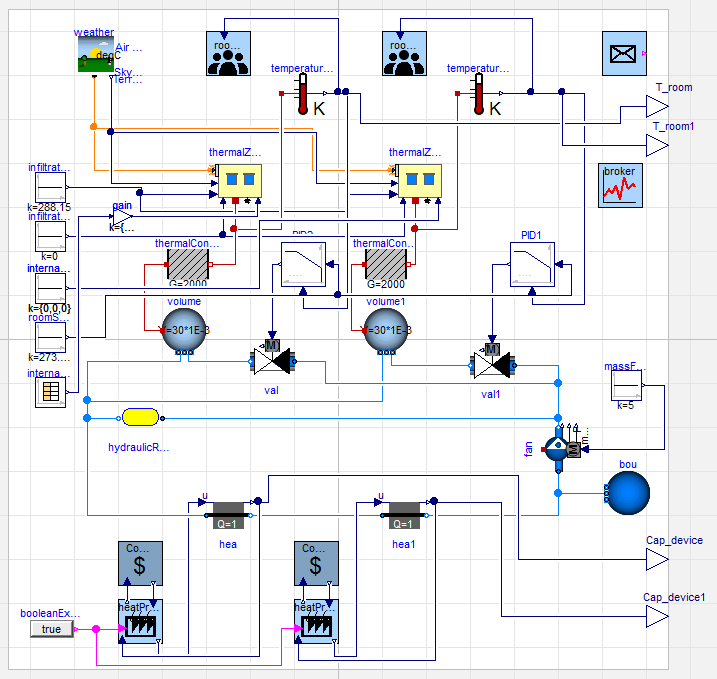
Below you see an example building energy system which can be found here. The system consists of two thermal zones (or rooms) and two heat producers e.g. a heat pump and a boiler. The system is set up as described in the section above. For a more detailed description please refer to the model itself. There are more examples available in the Example package if you need further input.
- December 2016, by Roozbeh Sangi:
Revised. - November 2016, by Felix Bünning:
Original implementation