modelScenarioRT
Information
Provisional french building regulation scenarios (RT 2012) 9th version [CSTB]
Hypothesis and equations
Hourly scenarios on a full year of the RT2012. The following scenarios are included in this model:
- occupant (heat inputs, vapors and presence 0/1)
- specific uses of electricity (thermal and vapor inputs)
- domestic hot water needs (debit and consumption)
- lighting
- ventilation
- heating and cooling
The data being discrete and with an hourly time step, the interpolation is performed by a step function (see the block BuildSysPro.BoundaryConditions.Scenarios.StepFunctionMat).
The model uses simulation time modulo 1 year (31536000s = 3600 * 8760). Therefore if the simulation is run several years, the scenario is repeated.
Bibliography
Version 9 of the 2012 French Building Regulation scenarios.
Instructions for use
This model reads a data file, containing the two tables below.
Table 1 :
Time [s] |
Hours |
Table 2 :
Hours |
Control for heating and cooling 1 = active 0 = setback period shorter than 48h -1 = setback period longer than 48 |
Ventilation setpoint 1 = operation 0 = stop or minimum value |
Lighting setpoint 1 = operation 0 = stop or minimum value |
Hot water consumption [%] Part of hot water consumed each hour Reference period (100%) is a week Reference volume set by |
Occupancy rate 1 = presence 0 = absence Possible modulation between 0 and 1 (ex : sleeping period) |
Internal gains by specific uses 1 = presence 0 = absence Possible modulation between 0 and 1 |
Water vapour generation out of occupancy and lighting 1 = presence 0 = absence Possible modulation between 0 and 1 |
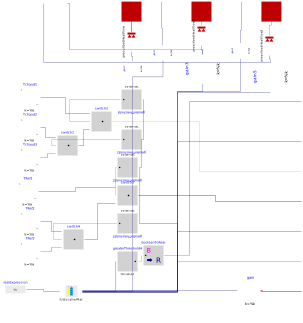
Scenarios describing the occupancy and specific uses provide "physical" information (superior ports of the model). The heat loads can be directly connected to an air node, and vapors inputs are in [kg steam/sec]. These are expressed through a RealOutput connector (causal modelling) and will then be adapted to the connectors selected for the multi-physics modelling.
The use of thermal ports is conditioned by the Booleans (UtilApportThOcc, UtilApportThUsageSpe, UtilApportThEclairage). In situations where these ports are not used but the Booleans are set to TRUE, the following error occurs:
Error: Singular inconsistent scalar system for scenarioRT.ApportsThOccupants.T = (scenarioRT.prescribedHeatFlow.Q_flow*(1-scenarioRT.prescribedHeatFlow.alpha*scenarioRT.prescribedHeatFlow.T_ref))/( -scenarioRT.prescribedHeatFlow.Q_flow*scenarioRT.prescribedHeatFlow.alpha) = .../-0
To fix the problem change the value of concerned booleans.
Right ports of the model correspond to "controls". They can be connected to models such as ventilation, hot water, lighting, heating and cooling or comfort analysis.
Note: In the RT2012 regulation, the environmental data are given in solar time whereas the data related to occupancy are in local time.
To account for this time difference (switch between winter and summer time), the user should choose a specific scenario file (for example ScenarioRT2012_timechange)
Known limits / Use precautions
None
Validations
Validated model but based on RT 2012 provisional scenarios - Gilles Plessis 02/2011
--------------------------------------------------------------
Licensed by EDF under a 3-clause BSD-license
Copyright © EDF 2010 - 2015
BuildSysPro version 3.6.0
Author : Gilles PLESSIS, EDF (2011)
--------------------------------------------------------------
Parameters
| Type | Name | Default | Description |
|---|---|---|---|
| BuildSysPro.Utilities.Types.FileNameIn | pth | Modelica.Utilities.Files.loadResource("modelica://BuildSysPro/Resources/Donnees/Scenarios/ScenarioRT2012.txt") | Chemin d'acces au fichier des scénarios (contient les 2 tables voir Scenarios.StepFunctionMat) |
| Heating and cooling setpoints | |||
| Modelica.Units.NonSI.Temperature_degC | TconsChaud | 19 | Setpoint temperature in heating mode |
| Modelica.Units.NonSI.Temperature_degC | TconsChaudInf48Red | 16 | Setpoint temperature in heating mode for setback period shorter than 48h |
| Modelica.Units.NonSI.Temperature_degC | TconsChaudSup48Red | 7 | Setpoint temperature in heating mode for setback period longer than 48h |
| Modelica.Units.NonSI.Temperature_degC | TconsRef | 28 | Setpoint temperature in cooling mode |
| Modelica.Units.NonSI.Temperature_degC | TconsRefInf48Red | 30 | Setpoint temperature in cooling mode for setback period shorter than 48h |
| Modelica.Units.NonSI.Temperature_degC | TconsRefSup48Red | 30 | Setpoint temperature in cooling mode for setback period longer than 48h |
| Optional internal heat loads | |||
| Boolean | UtilApportThOcc | false | Internal heat gains due to human occupancy |
| Boolean | UtilApportThUsageSpe | false | Internal heat gains for specific uses |
| Boolean | UtilApportThEclairage | false | Internal heat gains due to lighting |
| Occupants | |||
| Real | Nadeq | 1 | [NADEQ] Number of "equivalent" adult |
| Occupancy | |||
| Real | caloOccupant | 90 | [W/NADEQ] Average heat load for an "equivalent" adult |
| Real | humiOccupant | 0.055 | [kg/h/NADEQ] Humidity released by an "equivalent" adult |
| Others › DHW | |||
| Real | consoECShebdo | 0 | [L/week/NADEQ] Number of liters of water at 40°C consumed per week and per Nadeq. 0 in the RT, for a realistic value use 455 L/week/Nadeq |
| Others › Lighting | |||
| Real | unite1 | 0 | ex: Room surface area |
| Real | caloEclairage | 2 | [W/unite1] Heat gains by the lighting per unit (ex. living space) |
| Others › Specific uses | |||
| Real | caloUsageSpe | 5.7 | [W/unite1] Heat gains out of occupancy and lighting, per unit (ex. living space) |
| Real | unite2 | 0 | ex: Considered room surface area or number of showers or beds... |
| Real | HumiUsageSpe | 0 | [kg/h/unite2] Moisture production out of occupancy and lighting, per unit |
Connectors
| Type | Name | Default | Description |
|---|---|---|---|
| Modelica.Blocks.Interfaces.RealOutput | Presence | Presence 1 / Absence 0 | |
| Modelica.Blocks.Interfaces.RealOutput | ComRefChauffage | Control for heating and cooling (1 = active, 0 setback period shorter than 48h, and -1 setback period longer than 48h) | |
| Modelica.Blocks.Interfaces.RealOutput | TconsigneChaud | Heating setpoint temperature [K] | |
| Modelica.Blocks.Interfaces.RealOutput | TconsigneRef | Cooling setpoint temperature [K] | |
| Modelica.Blocks.Interfaces.RealOutput | ComVenti | Ventilation setpoint (1=operation, 0=stop or minimum value) | |
| Modelica.Blocks.Interfaces.RealOutput | ComEclairage | Lighting setpoint (1=operation, 0= stop or minimum value) | |
| Modelica.Blocks.Interfaces.RealOutput | DebitECS | Hot water volume flow rate at 40°C [L/h] | |
| Modelica.Blocks.Interfaces.RealOutput | ConsoECS | Hot water consumption at 40°C [L] | |
| BuildSysPro.BaseClasses.HeatTransfer.Interfaces.HeatPort_a | ApportsThOccupants | Heat gains from occupancy [W] | |
| BuildSysPro.BaseClasses.HeatTransfer.Interfaces.HeatPort_a | ApportsThUsageSpe | Heat gains from specific uses [W] (out of occupancy and lihghting) | |
| BuildSysPro.BaseClasses.HeatTransfer.Interfaces.HeatPort_a | ApportsThEclairage | Heat gains from lighting [W] | |
| Modelica.Blocks.Interfaces.RealOutput | ApportsHuOccupants | Moisture gains from occupancy [kg steam/s] | |
| Modelica.Blocks.Interfaces.RealOutput | ApportHuUsageSpe | Moisture gains from specific uses [kg steam/s] (out of occupancy and lighting) | |
| Modelica.Blocks.Interfaces.RealOutput | Usages | ||
| Modelica.Blocks.Interfaces.RealOutput | Eclairage |
Revisions
Gilles Plessis Février 2011: Le modèle devra être mis à jour notamment au niveau des valeurs de:
- consoECS (valeur estimée et non règlementaire),
- unite1,
- unite2,
- HumiUsageSpe.
Une mise à jour des ports pour apports humides (vapeur d'eau) devra aussi être envisagée.
Gilles Plessis Février2012:
- Correction d'un bug dû à la non utilisation des ports thermiques. Ils sont désormais optionels.
- Les températures sont désormais exprimées enn Kelvin au lieu de degré Celsius, comme pour les blocs météo.
- Modification du type du paramètre pth de String à Filename permettant l'utilisation d'une fenêtre pour atteindre le fichier de données.
Gilles Plessis Juin2012
- Ajout du connecteur Presence en sortie. C'est un réel (RealOutput) égal à 1 lorsque le bâtiment est occupé et 0 lorsque le bâtiment est vide.
- Une partie des composants jugés non utiles aux simulations ont été migrés en internes (protected)
Gilles Plessis 10/2012 : gain4 divisé par 3600
Gilles Plessis 11/2012 :
- l'interpolation est maintenant réalisée par des fonctions en escalier,
- le nombre d'adultes équivalents est modifiable y compris lorsque l'on n'utilise pas de les apports thermiques humains,
- le scénario peut être utilisé pour une simulation de plusieurs année. Il y a dans ce cas une répétition du scénario,
- ajout de sorties pour le débit et la consommation d'ECS. Suppression de l'ancienne sortie BesoinsECS,
- le paramètre pth, chemin d'accès au fichier de scénario, est conservé. Cependant le fichier de scénario doit contenir les 2 tables data1 et data2. Dans le cas de scénarios personnels mettre à jour les scénarios pour le respect de ces consignes. Voir aussi l'utilisation du bloc Utilitaires.Scenario.FctEscalierMat,
- modification du nom du paramètre consoECS en consoECShebdo.
Sila Filfli 04/2013 :
- Ajout des ports pour les apports (usages spécifiques, éclairage, ...)
Gilles Plessis 05/2013 : Modification de la valeur par défaut de la consommation hebdomadaire d'ECS de 50 L à 0L correspondant à la valeur RT. Pour information, la valeur de 455L/semaine/personne est recommandée.
Gilles Plessis 09/2015 : Utilisation de la fonction Modelica.Utilities.Files.loadResource pour le chargement de fichiers, pour une meilleure compatibilité avec le standard Modelica.
Benoît Charrier 01/2016 : Passage des valeurs de seuil des blocs GreaterThreshold à x+1e-6 pour contourner le mauvais comportement sous OpenModelica de ce type de bloc.