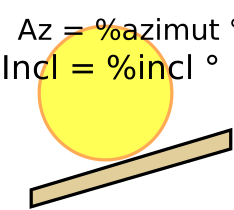
modelFLUXsurfLWRinc
Information
Hypothesis and equations
none
Bibliography
none
Instructions for use
Model which takes as input the vector G from a weather reader to calculate the surface irradiance on a particular surface (tilt and orientation given). G contains:
- (1) Horizontal diffuse flux
- (2) Normal direct flux
- (3) Horizontal direct flux
- (4) Horizontal global flux
- (5) Time in UTC at time t = 0 (start of the simulation)
- (6-7-8) Sun's direction cosines (6-sinH, 7-cosW, 8-cosS)
- (9) Solar azimuth angle
- (10) Solar elevation angle
You can choose which diffuse model to use. The isotropic diffuse model is considered more conservative (tendency to underestimate the incident radiation on an inclined plane) but is easier to use. The diffuse model Hay Davies Klucher Reindl (HDKR) is preferred in solar applications (photovoltaic, solar thermal ...).
Known limits / Use precautions
none
Validations
none
--------------------------------------------------------------
Licensed by EDF under a 3-clause BSD-license
Copyright © EDF 2009 - 2023
BuildSysPro version 3.6.0
Author : Aurélie KAEMMERLEN, EDF (2010)
--------------------------------------------------------------
Parameters
| Type | Name | Default | Description |
|---|---|---|---|
| Modelica.Units.NonSI.Angle_deg | azimut | Surface azimuth (Orientation relative to the south) - S=0°, E=-90°, W=90°, N=180° | |
| Modelica.Units.NonSI.Angle_deg | incl | Surface tilt - downwards = 180° skyward = 0°, vertical = 90° | |
| Real | albedo | 0.2 | Albedo of the environment |
| Integer | diffus_isotrope | 1 | Model for diffuse irradiance |
Connectors
| Type | Name | Default | Description |
|---|---|---|---|
| Modelica.Blocks.Interfaces.RealInput[10] | G | Inputs data {DIFH, DIRN, DIRH, GLOH, t0, CosDir[1:3], solar azimuth angle, solar elevation angle} | |
| BuildSysPro.BoundaryConditions.Solar.Interfaces.SolarFluxOutput | FluxIncExt | Global irradiance in [W/m²] |
Components
| Type | Name | Default | Description |
|---|---|---|---|
| FLUXsurf | fLUXsurf | ||
| Modelica.Blocks.Math.Add | add |
Revisions
Aurélie Kaemmerlen 05/2011 : Vecteur Gh de dimension 9 (anciennement 6) pour ajouter les entrées CoupleFlux, MoyFlux et dt
Hassan Bouia 03/2013 : simplication du calcul solaire - attention nouvelle dimension du vecteur Gh renommé en G
Amy Lindsay 03/2013 : ajout du paramètre diffus_isotrope pour choisir entre un modèle de diffus isotrope ou le modèle de diffus HDKR