blockCombiTable1Ds_ForStepMeteo
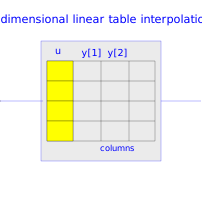
Extends from Modelica.Blocks.Interfaces.SIMO (Single Input Multiple Output continuous control block).
Information
Modification of CombiTable1Ds Modelica model in order to have a piecewise constant function adapted to meteorological data files
Hypothesis and equations
Constant piecewise interpolation in one dimension of a table. Via parameter columns it can be defined how many columns of the table are interpolated. If, e.g., icol={2,4}, it is assumed that one input and 2 output signals are present and that the first output interpolates via column 2 and the second output interpolates via column 4 of the table matrix.
Notes:
- The interpolation is efficient, because a search for a new interpolation starts at the interval used in the last call.
- If the table has only one row, the table value is returned, independent of the value of the input signal.
- If the input signal u is outside of the defined interval, i.e., u > table[size(table,1),1] or u < table[1,1], the corresponding value is also determined by linear interpolation through the last or first two points of the table.
- The grid values (first column) have to be strictly increasing.
Bibliography
Derived from the Modelica.Blocks.Tables.CombiTable1Ds model .
Instructions for use
The grid points and function values are stored in a matrix "table[i,j]", where the first column "table[:,1]" contains the grid points and the other columns contain the data to be interpolated. Example:
   table = [0,  0;
            1,  1;
            2,  4;
            4, 16]
   If, e.g., the input u = 1.0, the output y =  1.0,
       e.g., the input u = 1.5, the output y =  2.5,
       e.g., the input u = 2.0, the output y =  4.0,
       e.g., the input u =-1.0, the output y = -1.0 (i.e., extrapolation).
The table matrix can be defined in the following ways:
- Explicitly supplied as parameter matrix "table", and the other parameters have the following values:
- Read from a file "fileName" where the matrix is stored as "tableName". Both ASCII and MAT-file format is possible. (The ASCII format is described below). The MAT-file format comes in four different versions: v4, v6, v7 and v7.3. The library supports at least v4, v6 and v7 whereas v7.3 is optional. It is most convenient to generate the MAT-file from FreeMat or MATLAB® by command
- Statically stored in function "usertab" in file "usertab.c". The matrix is identified by "tableName". Parameter fileName = "NoName" or has only blanks. Row-wise storage is always to be preferred as otherwise the table is reallocated and transposed. See the Tables package documentation for more details.
   tableName is "NoName" or has only blanks,
   fileName  is "NoName" or has only blanks.
save tables.mat tab1 tab2 tab3
or Scilab by command
savematfile tables.mat tab1 tab2 tab3
when the three tables tab1, tab2, tab3 should be used from the model.
Note, a fileName can be defined as URI by using the helper function loadResource.
When the constant "NO_FILE_SYSTEM" is defined, all file I/O related parts of the source code are removed by the C-preprocessor, such that no access to files takes place.
If tables are read from an ASCII-file, the file needs to have the following structure ("-----" is not part of the file content):
-----------------------------------------------------
#1
double tab1(5,2)   # comment line
  0   0
  1   1
  2   4
  3   9
  4  16
double tab2(5,2)   # another comment line
  0   0
  2   2
  4   8
  6  18
  8  32
-----------------------------------------------------
Note, that the first two characters in the file need to be "#1" (a line comment defining the version number of the file format). Afterwards, the corresponding matrix has to be declared with type (= "double" or "float"), name and actual dimensions. Finally, in successive rows of the file, the elements of the matrix have to be given. The elements have to be provided as a sequence of numbers in row-wise order (therefore a matrix row can span several lines in the file and need not start at the beginning of a line). Numbers have to be given according to C syntax (such as 2.3, -2, +2.e4). Number separators are spaces, tab ( ), comma (,), or semicolon (;). Several matrices may be defined one after another. Line comments start with the hash symbol (#) and can appear everywhere. Other characters, like trailing non comments, are not allowed in the file.
MATLAB is a registered trademark of The MathWorks, Inc.
Known limits / Use precautions
none
Validations
Validated model
--------------------------------------------------------------
Licensed by EDF under a 3-clause BSD-license
Copyright © EDF 2009 - 2023
BuildSysPro version 3.6.0
Author : Hassan BOUIA, Amy LINDSAY, EDF (2014)
--------------------------------------------------------------
Parameters
| Type | Name | Default | Description |
|---|---|---|---|
| Integer | nout (from SIMO) | 1 | Number of outputs |
| Real | delta_t | 3600 | Constant time step of the file in [s] |
| Integer[nout] | option | fill(1, nout) | =0 if piecewise constant function |
| Table data definition | |||
| Boolean | tableOnFile | false | = true, if table is defined on file or in function usertab |
| Real[:,:] | table | fill(0.0, 0, 2) | Table matrix (grid = first column; e.g., table=[0,2]) |
| String | tableName | "NoName" | Table name on file or in function usertab (see docu) |
| String | fileName | "NoName" | File where matrix is stored |
| Boolean | verboseRead | true | = true, if info message that file is loading is to be printed |
| Table data interpretation | |||
| Integer[:] | columns | 2:size(table, 2) | Columns of table to be interpolated |
| Modelica.Blocks.Types.Smoothness | smoothness | Modelica.Blocks.Types.Smoothness.LinearSegments | Smoothness of table interpolation |
Connectors
| Type | Name | Default | Description |
|---|---|---|---|
| RealInput | u (from SIMO) | Connector of Real input signal | |
| RealOutput[nout] | y (from SIMO) | Connector of Real output signals |
Components
| Type | Name | Default | Description |
|---|---|---|---|
| Real | u1 | integer(u/delta_t)*delta_t + delta_t/2 |
Contents
| Name | Description |
|---|---|
 readTableDataprotected readTableDataprotected | Read table data from ASCII text or MATLAB MAT-file |
 getTableValueprotected getTableValueprotected | Interpolate 1-dim. table defined by matrix |
 getTableValueNoDerprotected getTableValueNoDerprotected | Interpolate 1-dim. table defined by matrix (but do not provide a derivative function) |
 getDerTableValueprotected getDerTableValueprotected | Derivative of interpolated 1-dim. table defined by matrix |
Revisions
12/2014 H. Bouia, A. Lindsay : modification du modèle CombiTable1Ds de Modelica afin que la fonction en escaliers corresponde bien à ce qu'on attend en sortie d'un fichier météo