modelZoneCrawlSpace
Information
Model of parallelepiped unglazed zone on crawl space, in pure thermal modelling
Hypothesis and equations
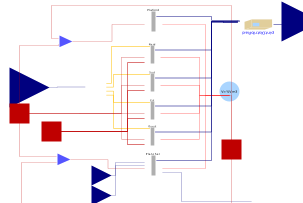
Parallelepiped unglazed single-zone building on crawl space model, to be connected to a boundary conditions model (left thermal port) and a left realOutput for solar fluxes. By default walls are oriented in the four cardinal points; the orientation modification is represented by the parameter beta. The right thermal port is connected to the inner volume (heat capacity). Floor and ceiling are subject to outside temperatures which are weighted by a coefficient b.
Bibliography
none
Instructions for use
This single zone building model is to be connected to a weather boundary conditions model on the left (outside temperature, sunlight-related data). The right thermal port is connected to the inner volume (heat capacity) and can, if desired, be connected to any model using a thermal port (internal heat gains...).
The walls parameterization is done via the parameter caracParoi, however it still can be done layer by layer without creating any type of wall.
- Click on the small arrow of caracParoi + Edit
- Fill in the fields on the number of layers, their thickness, the mesh. The parameter positionIsolant is optional
- For the mat parameter, click on the small arrow + Edit array, match the number of boxes in a column to the number of materials layer in the window that is displayed, then, in each box, right-click + Insert function call and browse the library to specify the path of the desired material (in
Utilities.Data.Solids)
Known limits / Use precautions
To consider walls radiation in long wavelength (LWR), exchange coefficients h must be global exchange coefficients.
Validations
Validated model - Ludovic Darnaud 07/2010
--------------------------------------------------------------
Licensed by EDF under a 3-clause BSD-license
Copyright © EDF 2009 - 2023
BuildSysPro version 3.6.0
Author : Ludovic DARNAUD, EDF (2010)
--------------------------------------------------------------
Parameters
| Type | Name | Default | Description |
|---|---|---|---|
| Modelica.Units.SI.Volume | Vair | Indoor air volume | |
| Real | beta | 0 | Correction of vertical walls azimuth (azimuth=azimuth{0,90,180,-90}+beta) |
| Boolean | ChoixPint | false | Consideration of radiative contributions in proportion to surfaces |
| Boolean | ChoixGLOext | false | Consideration of LW radiation (infrared) between vertical walls and the sky |
| Real | bCombles | 0.5 | Weighting coefficient of ceiling temperatures on lost roofs |
| Real | bVS | 0.5 | Weighting coefficient of floor temperatures on crawl space |
| Initialisation parameters | |||
| Modelica.Units.SI.Temperature | Tair | 293.15 | Indoor air initial temperature |
| Modelica.Units.SI.Temperature | Tp | 293.15 | Walls initial temperature |
| BuildSysPro.Utilities.Types.InitCond | InitType | BuildSysPro.Utilities.Types.InitCond.SteadyState | |
| Vertical walls | |||
| BuildSysPro.Utilities.Records.GenericWall | CaracParoiVert | Vertical walls characteristics | |
| Modelica.Units.SI.Area | S1nv | 1 | South wall surface (unglazed) |
| Modelica.Units.SI.Area | S2nv | 1 | West wall surface (unglazed) |
| Modelica.Units.SI.Area | S3nv | 1 | North wall surface (unglazed) |
| Modelica.Units.SI.Area | S4nv | 1 | East wall surface (unglazed) |
| Modelica.Units.SI.CoefficientOfHeatTransfer | hextv | ||
| Modelica.Units.SI.CoefficientOfHeatTransfer | hintv | ||
| Real | albedo | 0.2 | Environment albedo |
| Real | alpha | 0.6 | Absorption coefficient of the outer surface in the visible |
| Real | eps | 0.6 | Emissivity in LWR |
| Horizontal walls › Ceiling | |||
| BuildSysPro.Utilities.Records.GenericWall | CaracPlaf | Ceiling characteristics | |
| Modelica.Units.SI.Area | Splaf | 1 | Ceiling surface |
| Modelica.Units.SI.CoefficientOfHeatTransfer | hplaf | ||
| Modelica.Units.SI.CoefficientOfHeatTransfer | hintplaf | ||
| Horizontal walls › Floor | |||
| Integer | PlancherActif | 1 | |
| Modelica.Units.SI.Area | Splanch | 1 | Floor surface |
| Modelica.Units.SI.CoefficientOfHeatTransfer | hplanch | ||
| Modelica.Units.SI.CoefficientOfHeatTransfer | hintplanch | ||
| Integer | nP | 1 | Number of the layer whose upper border is the site of power injection - must be strictly lower than n |
| Integer | nD | 8 | Number of discretization slices of the water floor |
| Modelica.Units.SI.Distance | Ltube | 128 | Floor heating coil length |
| Modelica.Units.SI.Distance | DiametreInt | 0.013 | Inner diameter of tube |
| Modelica.Units.SI.Distance | eT | 0.0015 | Tube thickness |
| Horizontal walls › Plancher | |||
| BuildSysPro.Utilities.Records.GenericWall | CaracPlanch | Floor characteristics | |
| Parois Horizontales › Floor | |||
| Modelica.Units.SI.ThermalConductivity | lambdaT | 0.35 | Tube thermal conductivity |
Connectors
| Type | Name | Default | Description |
|---|---|---|---|
| Modelica.Blocks.Interfaces.RealInput[10] | G | Sun data : {DIFH, DIRN, DIRH, GLOH, t0, CosDir[1:3], Solar azimuth angle, Solar elevation angle} | |
| BuildSysPro.BaseClasses.HeatTransfer.Interfaces.HeatPort_a | T_ext | ||
| BuildSysPro.BaseClasses.HeatTransfer.Interfaces.HeatPort_a | T_int | ||
| Modelica.Blocks.Interfaces.RealInput[2] | WaterIn | Vector containing 1-the fluid temperature (K), 2-the flow(kg/s) | |
| Modelica.Blocks.Interfaces.RealOutput[2] | WaterOut | Vector containing 1-the fluid temperature (K), 2-the flow(kg/s) | |
| Modelica.Blocks.Interfaces.RealInput | PelecPRE | Electric power injected into the floor | |
| Modelica.Blocks.Interfaces.RealInput | Pint | Internal radiative heat gains | |
| BaseClasses.HeatTransfer.Interfaces.HeatPort_a | T_ciel |
Components
| Type | Name | Default | Description |
|---|---|---|---|
| BuildingEnvelope.HeatTransfer.B_Coefficient | coefficient_bVS | ||
| BoundaryConditions.Radiation.PintRadDistrib | pintDistribRad | Distribution proportionally to surfaces of any radiative flux |
Revisions
Gilles Plessis 02/2011: Changement du modèle de coefficient B pour vérifier la conservation d'énergie + Ajout d'une liste déroulante pour le choix des matériaux via l'annotation annotation(choicesAllMatching=true)
Aurélie Kaemmerlen 03/2011 : Remplacement des modèles de ParoiEclairee et FenetreSimple par ParoiRad et FenetreRad avec externalisation du calcul des flux solaires incidents
Gilles Plessis 02/2012 : Suppression du modifier each dans la définition des matériaux des parois. Le mot clé each n'a pas à être présent car les matériaux des parois sont définis en temps que vecteur.
Gilles Plessis 02/2012 : Modification du type de paroi pour le plancher et le plafond de paroiComplete en paroi
Gilles Plessis 06/2012 :
- Intégration du changement de paramétrage des parois. Voir les révisions apportées au modèle de parois
- Protection de composants pour éviter le grand nombre de variables dans la fenêtre des résultats.
Vincent Magnaudeix 06/2012 : Coefficient b de réduction de température distinct pour le plafond et le plancher
Aurélie Kaemmerlen 07/2012 : Ajout de booléens supplémentaires présents dans les parois
- Plancher chauffant électrique ou à eau,
- Rayonnement avec le ciel pour les parois verticales,
- Injection d'un flux radiatif (via des panneaux rayonnants par exemple, avec distribution au prorata des surfaces)
Amy Lindsay 03/2014 : changement des FluxSolInput en RealInput pour les apports internes Pint