modelSingleMixing
Single mixing circuit
Extends from BaseClasses.SingleMixing.
Information
Summary
This configuration (see schematic below) is used for variable flow primary circuits and either constant flow or variable flow secondary circuits that have a design supply temperature identical to the primary circuit but a varying set point during operation.
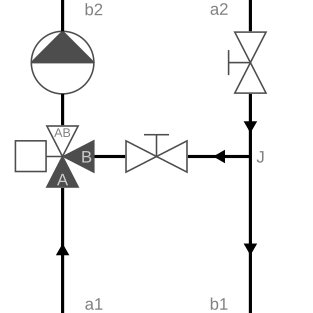
The following table presents the main characteristics of this configuration.
| Primary circuit | Variable flow |
| Secondary (consumer) circuit | Constant or variable flow |
| Typical applications | Widely used in heating applications as it is very simple to achieve. |
| Non-recommended applications | Low-temperature systems that would require the control valve to be operated on a limited opening range: use Buildings.Fluid.HydronicConfigurations.PassiveNetworks.DualMixing instead. |
| Built-in valve control options | Supply temperature |
|
Control valve selection (See the nomenclature in the schematic.) |
β = ΔpA-AB /
(Δp1 + ΔpA-AB) The control valve is sized with a pressure drop equal to the maximum of Δp1 and 3e3 Pa. |
| Balancing requirement | In most cases the bypass balancing valve is not needed. However, it may be needed to counter negative back pressure created by other served circuits, see Buildings.Fluid.HydronicConfigurations.PassiveNetworks.Examples.SingleMixingOpenLoop. |
|
Lumped flow resistance includes (With the setting use_lumFloRes=true.)
|
Control valve val and primary balancing valve res1
|
Additional comments
The parameter dp1_nominal stands for the potential
primary back pressure and must be provided as an absolute value.
By default the secondary pump is parameterized with
a design pressure rise equal to
dp2_nominal + dpBal2_nominal +
max({val.dpValve_nominal + dp1_nominal, val.dp3Valve_nominal + dpBal3_nominal}
.
Revisions
-
June 30, 2022, by Antoine Gautier:
First implementation.