
modelAllosteric_Hemoglobin_MWC
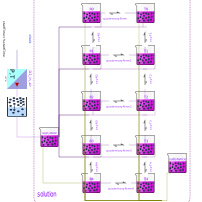
Extends from Modelica.Icons.Example (Icon for runnable examples).
Information
To understand the model is necessary to study the principles of MWC allosteric transitions first published by
[1] Monod,Wyman,Changeux (1965). "On the nature of allosteric transitions: a plausible model." Journal of molecular biology 12(1): 88-118.
In short it is about binding oxygen to hemoglobin.
Oxgen are driven by its partial pressure using clock source - from very little pressure to pressure of 10kPa.
(Partial pressure of oxygen in air is the air pressure multiplied by the fraction of the oxygen in air.)
Hemoglobin was observed (by Perutz) in two structuraly different forms R and T.
These forms are represented by blocks T0..T4 and R0..R4, where the suffexed index means the number of oxygen bounded to the form.
In equilibrated model can be four chemical reactions removed and the results will be the same, but dynamics will change a lot. ;)
If you remove the quaternaryForm1,quaternaryForm2,quaternaryForm3,quaternaryForm4 then the model in equilibrium will be exactly the same as in MWC article.
Parameters was fitted to data of Severinghaus article from 1979. (For example at pO2=26mmHg is oxygen saturation sO2 = 48.27 %).
Parameters
| Type | Name | Default | Description |
|---|---|---|---|
| Modelica.Units.SI.AmountOfSubstance | THb | 0.001 | Total amount of hemoglobin |
| Modelica.Units.SI.Temperature | T | 298.15 | Base Temperature |
| Real | RT | Modelica.Constants.R*T | |
| Modelica.Units.SI.Volume | OneLiter | 0.001 | |
| Real | L | 7.0529*10^6 | =[T0]/[R0] .. dissociation constant of relaxed <-> tensed change of deoxyhemoglobin tetramer |
| Real | c | 0.00431555 | =KR/KT .. ration between oxygen affinities of relaxed vs. tensed subunit |
| Modelica.Units.SI.Concentration | KR | 0.000671946*(55.508/38.7) | Oxygen dissociation coefficient on relaxed(R) hemoglobin subunit |
| Real | KRx | (KR*OneLiter) | Mole fraction based KR |
| Modelica.Units.SI.MolarEnergy | GO2aq | -RT*log(0.0013) | |
| Modelica.Units.SI.MolarEnergy | GR0 | 0 | |
| Modelica.Units.SI.MolarEnergy | GT0 | GR0 - RT*log(L) | |
| Modelica.Units.SI.MolarEnergy | GR1 | GR0 + GO2aq + RT*log(KRx/4) | |
| Modelica.Units.SI.MolarEnergy | GT1 | GR1 - RT*log(c*L) | |
| Modelica.Units.SI.MolarEnergy | GR2 | GR1 + GO2aq + RT*log(KRx/(3/2)) | |
| Modelica.Units.SI.MolarEnergy | GT2 | GR2 - RT*log(c^2*L) | |
| Modelica.Units.SI.MolarEnergy | GR3 | GR2 + GO2aq + RT*log(KRx/(2/3)) | |
| Modelica.Units.SI.MolarEnergy | GT3 | GR3 - RT*log(c^3*L) | |
| Modelica.Units.SI.MolarEnergy | GR4 | GR3 + GO2aq + RT*log(KRx*4) | |
| Modelica.Units.SI.MolarEnergy | GT4 | GR4 - RT*log(c^4*L) | |
| Real | KC | 0.0001 | Slow down factor |
Components
Revisions
2013-2018
Marek Matejak, Charles University, Prague, Czech Republic