modelThreeElements
Thermal Zone with three elements for exterior walls,
interior walls and floor plate
Extends from TwoElements.
Information
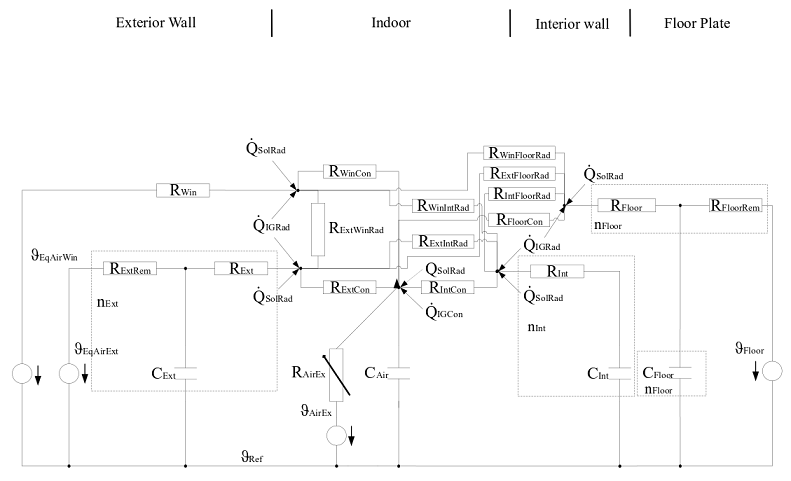
This model adds one further element for
the floor plate. Long-term effects dominate the excitation of the floor plate
and thus the excitation fundamentally differs from excitation of outer walls.
Adding an extra element for the floor plate leads to a finer resolution of the
dynamic behaviour but increases calculation times. The floor plate is
parameterized via the length of the RC-chain nFloor,
the vector of the capacities
CFloor[nFloor], the vector of the resistances
RFloor[nFloor]
and the remaining resistance RFloorRem.
The image below shows the RC-network of this model.
Parameters
| Type | Name | Default | Description |
|---|---|---|---|
| Floor plate | |||
| Modelica.SIunits.Area | AFloor | Area of floor plate | |
| Modelica.SIunits.CoefficientOfHeatTransfer | alphaFloor | Convective coefficient of heat transfer of floor plate (indoor) | |
| Integer | nFloor | Number of RC-elements of floor plate | |
| Modelica.SIunits.ThermalResistance[nExt] | RFloor | Vector of resistances of floor plate, from inside to outside | |
| Modelica.SIunits.ThermalResistance | RFloorRem | Resistance of remaining resistor RFloorRem between capacity n and outside | |
| Modelica.SIunits.HeatCapacity[nExt] | CFloor | Vector of heat capacities of floor plate, from inside to outside | |
| Boolean | indoorPortFloor | false | Additional heat port at indoor surface of floor plate |
Components
| Type | Name | Default | Description |
|---|---|---|---|
| Modelica.Thermal.HeatTransfer.Interfaces.HeatPort_a | floor | Ambient port for floor plate | |
| Modelica.Thermal.HeatTransfer.Interfaces.HeatPort_a | floorIndoorSurface | Auxiliary port at indoor surface of floor plate | |
| BaseClasses.ExteriorWall | floorRC | RC-element for floor plate |
Revisions
-
August 31, 2018 by Moritz Lauster:
Updated schema in documentation to fix issue 997. -
July 15, 2015 by Moritz Lauster:
First Implementation.