modelTwoElements
Thermal Zone with two elements for exterior and interior walls
Extends from OneElement.
Information
This model distinguishes between internal
thermal masses and exterior walls. While exterior walls contribute to heat
transfer to the ambient, adiabatic conditions apply to internal masses.
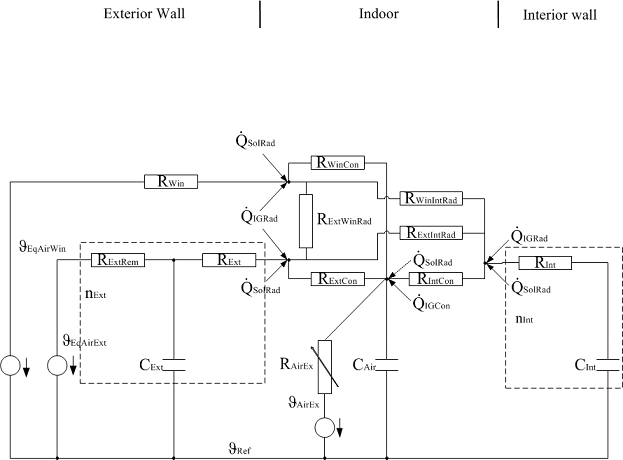
Parameters for the internal wall element are the length of the RC-chain
nInt, the vector of the capacities
CInt[nInt] and the vector of the resistances RInt[nInt].
This approach allows considering the dynamic behaviour induced by internal
heat storage.
The image below shows the RC-network of this model.
Parameters
| Type | Name | Default | Description |
|---|---|---|---|
| Interior walls | |||
| Modelica.SIunits.Area | AInt | Area of interior walls | |
| Modelica.SIunits.CoefficientOfHeatTransfer | alphaInt | Convective coefficient of heat transfer of interior walls (indoor) | |
| Integer | nInt | Number of RC-elements of interior walls | |
| Modelica.SIunits.ThermalResistance[nInt] | RInt | Vector of resistances of interior walls, from port to center | |
| Modelica.SIunits.HeatCapacity[nInt] | CInt | Vector of heat capacities of interior walls, from port to center | |
| Boolean | indoorPortIntWalls | false | Additional heat port at indoor surface of interior walls |
Components
| Type | Name | Default | Description |
|---|---|---|---|
| Modelica.Thermal.HeatTransfer.Interfaces.HeatPort_a | intWallIndoorSurface | Auxiliary port at indoor surface of interior walls | |
| BaseClasses.InteriorWall | intWallRC | RC-element for interior walls |
Revisions
-
April 18, 2015, by Moritz Lauster:
First implementation.