
classConcept
Extends from Modelica.Icons.Information (Icon for general information packages).
Information
The fundamentals of this library are presented in [Brkic2019].
The PhotoVoltaics library relies on simple electric equivalent circuit models of photovoltaic cells. Simple photovoltaic modules consist of a series connection of individual cells such that shadowing effects can be considered. Alternatively, a simple symmetric module consistst solely of a single, scaled cell model which calculates cell voltage, current and power, internally. A simple symmetric plant is as well a single, scaled model of a cell, considering the series connections of a module and the series and parallel connectrions of a plant.
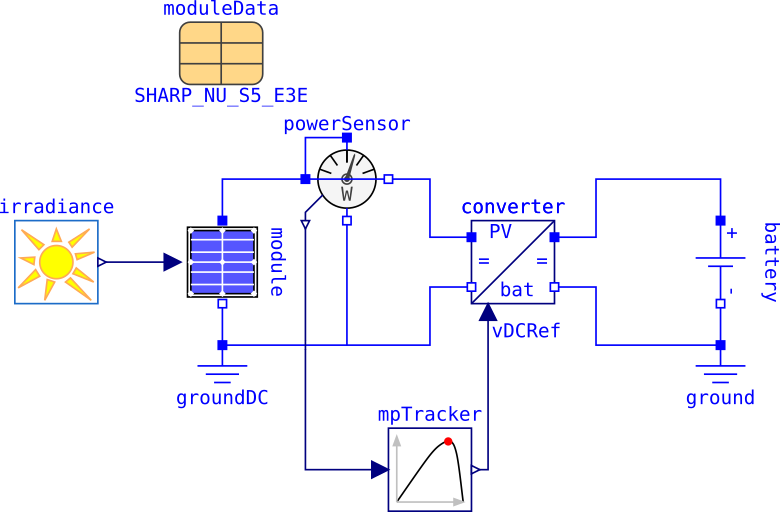
Each photovoltaic (PV) component has to be coupled with a converter to deliver power to either an energy storage or the electric grid. In the PhotoVoltaics libaray the DC/DC and DC/AC converters are provided. In the quasi static domain a single-phase and a three-phase converter are provided. For time transient models there is currently only a three phase converter provided. The converter models consider
- no loss of the semiconductors,
- ideal control of the DC voltage of the PV component.
In order to operate each PV component in the maximum power point, a maximum power tracker is provied. In the actual version only a sampling tracker is available.
Different solar irradiance sources may be used with PhotoVoltaics library
- Analytical terrestric solar model depending on
- latitude
- longitude
- absoulte time
- a reference irradiance of the sun
- azimut and inclination angle of the used PV component
- Irradiance terrestric model with variable location of the azimuth and then angle of inclination of the PV component
- Irradiance Model without time dependency and terrestric data; sun location is fixed such that extraterrestrial solar radiation can be investsigated
- Measurement data read from file such as implemented in PhotoVoltaics_TGM
Different PV module parameters of different manufacturers are provided as parameter records. The required module parameters are shown in ModuleData.