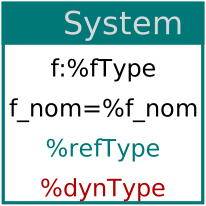
modelSystem
System reference
Information
The model System represents a global reference for the following purposes:
It allows the choice of
- nominal frequency (default 50 or 60 Hertz, but arbitrary positive choice allowed)
- system frequency or initial system frequency, depending on frequency type
- frequency type: parameter, signal, or average (machine-dependent) system frequency
- lower and upper limit-frequencies
- common phase angle for AC-systems
- synchronous or inertial reference frame for AC-3phase-systems
- transient or steady-state initialisation and simulation modes
For 'transient' initialisation no specific initial equations are defined.
This case allows also to use Dymola's steady-state initialisation, that is DIFFERENT from ours.
Note: the parameter 'sim' only affects AC three-phase components.
It provides
- the system angular-frequency omega
For fType Parameter this is simply a parameter value.
For fType Signal it is a positive input signal.
For fType Average it is a weighted average over the relevant generator frequencies. - the system angle theta by integration of
der(theta) = omega
- the reference angle thetaRef for defining the coordinate-orientation:
thetaRef = theta if refType == Synchron (reference frame is synchronously rotating with theta).
thetaRef = 0 if refType == Inertial (inertial reference frame, not rotating). - the angle thetaRel = theta - thetaRef
Root-nodes defining coordinate-orientation will have the connector variable theta = {thetaRel, thetaRef}
Note: Each model using System must use it with an inner declaration and
instance name system in order that it can be accessed from all objects in the model.
When dragging the 'System' from the package browser into the diagram layer, declaration and instance name are automatically generated.
Parameters
| Type | Name | Default | Description |
|---|---|---|---|
| SI.AngularFrequency | omega_nom | 2*pi*f_nom | nominal angular frequency |
| Boolean | synRef | refType == PowerSystems.Types.ReferenceFrame.Synchron or dynType == PowerSystems.Types.Dynamics.SteadyState | |
| Frequency | |||
| Types.SystemFrequency | fType | PowerSystems.Types.SystemFrequency.Parameter | system frequency type |
| SI.Frequency | f | f_nom | frequency if type is parameter, else initial frequency |
| SI.Frequency[2] | f_lim | {0.5*f_nom, 2*f_nom} | limit frequencies (for supervision of average frequency) |
| Nominal | |||
| SI.Frequency | f_nom | 50 | nominal frequency |
| SI.AngularVelocity | w_nom | 2*pi*f_nom | nom r.p.m. |
| System | |||
| SI.Angle | alpha0 | 0 | phase angle |
| Types.ReferenceFrame | refType | PowerSystems.Types.ReferenceFrame.Synchron | reference frame (3-phase) |
| Initialization | |||
| Types.Dynamics | dynType | PowerSystems.Types.Dynamics.SteadyInitial | transient or steady-state model |
Connectors
| Type | Name | Default | Description |
|---|---|---|---|
| Modelica.Blocks.Interfaces.RealInput | omega_in | system angular frequency (optional if fType==Signal) | |
| Interfaces.Frequency | receiveFreq | receives weighted frequencies from generators |
Components
| Type | Name | Default | Description |
|---|---|---|---|
| SI.Time | initime | ||
| SI.Angle | theta | system angle | |
| SI.Angle | thetaRel | theta - thetaRef | angle relative to reference frame |
| SI.Angle | thetaRef | if synRef then theta else 0 | angle of reference frame |
| SI.AngularFrequency | omega |