modelHair_Lynx_Interaction
Information
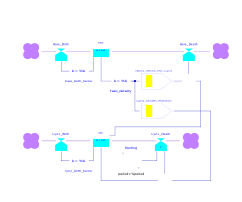
The hare/lynx interaction model is a typical two-species predator/prey model. This example has been borrowed from SystemDynamics 1.0. The original version of this example can be found in the STELLA tutorial.
References:
- Richmond, B., S. Peterson, and P. Vescuso (1987), An Academic User's Guide to STELLA, High Performance Systems, Inc., Lyme, N.H.
Simulate the model across 60 time units and plot the two animal populations against simulation time:
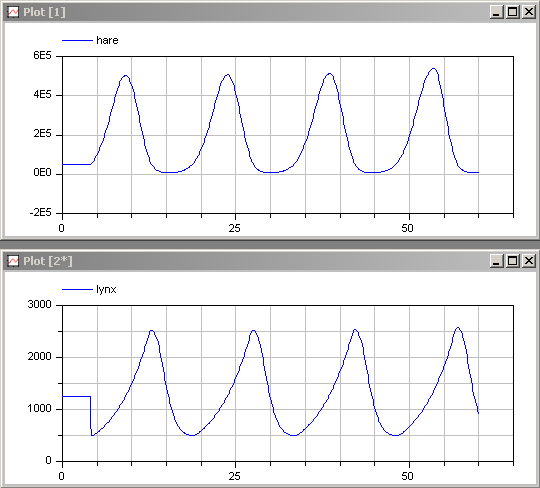
You need to reduce the accuracy to 1e-10 in order for the simulation to run correctly.
Also plot the two population against each other:
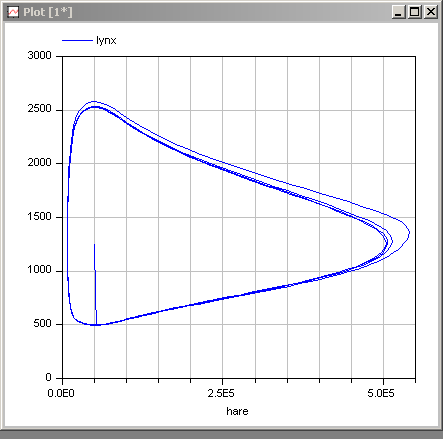
You shall notice that the limit cycle is mildly unstable.
The simulation results obtained are not exactly the same as with SystemDynamics 1.0. The reason is that the previous version used tabular interpolation functions with linear extrapolation, whereas the new version uses tabular interpolation functions without extrapolation capability (a more prudent approach). In line with STELLA philosophy, the support values of the two tabular functions were manually extended to reflect a constant rather than a linear extrapolation.
Components
| Type | Name | Default | Description |
|---|---|---|---|
| Real | hare | Hare population | |
| Real | lynx | Lynx population | |
| SystemDynamics.Levels.Level | Hare | ||
| SystemDynamics.Rates.Rate_1 | Hare_Birth | ||
| SystemDynamics.Auxiliary.Gain | hare_birth_factor | ||
| SystemDynamics.Sources.Source | Source1 | ||
| SystemDynamics.Auxiliary.Gain | hare_density | ||
| SystemDynamics.Functions.Tabular | Hares_Killed_Per_Lynx | ||
| SystemDynamics.Rates.Rate_1 | Hare_Death | ||
| SystemDynamics.Sources.Sink | Sink1 | ||
| SystemDynamics.Levels.Level | Lynx | ||
| SystemDynamics.Rates.Rate_1 | Lynx_Birth | ||
| SystemDynamics.Auxiliary.Gain | lynx_birth_factor | ||
| SystemDynamics.Sources.Source | Source2 | ||
| SystemDynamics.Rates.Rate_2 | Lynx_Death | ||
| SystemDynamics.Auxiliary.Prod_2 | prod_2_1 | ||
| SystemDynamics.Functions.Tabular | Lynx_Death_Fraction | ||
| SystemDynamics.Sources.Sink | Sink2 | ||
| Modelica.Blocks.Sources.Pulse | Hunting | ||
| SystemDynamics.Auxiliary.Prod_2 | prod_2_2 |