
blockNR_Resource_Utilization
Information
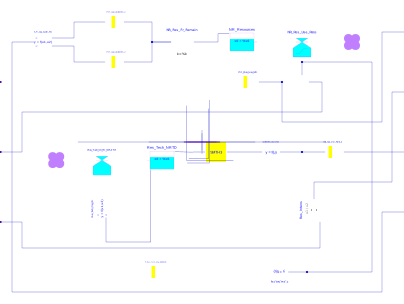
This model describes the utilization of non-recoverable natural resources. In the model (created in the early 1970s), the non-recoverable resources considered are mostly metals. They are thus measured in metric tons.From today's perspective, it might make more sense to concentrate on the remaining fossil fuels, which is not the approach that Meadows and his coworkers took. Yet, the effects of the dwindling resources on the overall economy are comparable, whether we can no longer produce goods, because we lack the raw materials or because we lack the energy to do so, results ultimately in the same predicament. Due to the laws of exponential growth, we are running out of all kind of natural resources (fossil fuels, minerals, fresh water) almost simultaneously.
In the case of minerals, recovery is partly possible, as discarded materials can be recycled. However doing so requires energy for the re-concentration of these scrap materials. The materials themselves don't get used up. They only get dissipated further and further, until their density is so low that they cannot be collected any longer within reasonable cost limits.
In the case of fossil fuels, these truly get used up. These resources are non-recoverable within human time constants. They were developed over many millions of years and essentially represent "fossil sunshine." Humanity is using all of these resources up within the very short time span (in geological terms) of a few hundred years. Peak Oil, i.e., the time when we shall have used up 50% of the available oil, and when supply can no longer keep up with demand, is now just around the corner.
The fantastic recent developments of technology and the medical sciences, accompanied by an unprecedented growth of human population, would not have been possible without these resources, and won't be maintainable, once they shall have been used up.
Whereas the earlier WORLD2 model only accounted for the dwindling resources themselves, the newer WORLD3 model offers a second state variable representing technological change. Through more advanced technology, it is possible to use the available resources more efficiently, and that effect is accounted for by the second state variable in the model.
In the WORLD3 model, the natural resources themselves are measured in metric tons, whereas the technology change has no units.
Parameters
| Type | Name | Default | Description |
|---|---|---|---|
| Real | des_res_use_rt_DNRUR | 4800000000.0 | Desired resource utilization rate |
| Real | nr_resources_init | 1000000000000.0 | Initial available non-recoverable resources |
| Real | p_nr_res_use_fact_1 | 1 | Default non-recoverable resource utilization factor |
| Real | res_tech_init | 1 | Initial non-recoverable resource technology factor |
| Real | t_policy_year | 4000 | Year of policy change |
| Real | t_fcaor_time | 4000 | Year of capital allocation to resource use efficiency |
| Real | tech_dev_del_TDD | 20 | Technology development time |
| Real[:] | p_fr_cap_al_obt_res_2 | {1, 0.2, 0.1, 0.05, 0.05, 0.05, 0.05, 0.05, 0.05, 0.05, 0.05} | Non-renewable resource fraction remaining |
| Real[:] | p_res_tech_chg_mlt | {0, 0, 0, 0} | Resource technology change multiplier |
Connectors
| Type | Name | Default | Description |
|---|---|---|---|
| SystemDynamics.Interfaces.MassInPort | ind_out_pc | Per capita annual industrial output | |
| SystemDynamics.Interfaces.MassInPort | population | Population | |
| SystemDynamics.Interfaces.MassOutPort | pc_res_use_mlt | Per capita resource utilization | |
| SystemDynamics.Interfaces.MassOutPort | s_fr_cap_al_obt_res | Fraction of capital allocated to resource use efficiency | |
| SystemDynamics.Interfaces.MassOutPort | ind_cap_out_ratio_2_ICOR2T | Industrial capital output ratio | |
| SystemDynamics.Interfaces.MassInPort | industrial_output | Annual industrial output | |
| SystemDynamics.Interfaces.MassOutPort | res_intens | Resource utilization intensity |
Components
| Type | Name | Default | Description |
|---|---|---|---|
| SystemDynamics.Levels.Level1b | NR_Resources | p.387 of Dynamics of Growth in a Finite World | |
| SystemDynamics.Rates.RRate | NR_Res_Use_Rate | p.389 of Dynamics of Growth in a Finite World | |
| SystemDynamics.Sources.Sink | Sink1 | ||
| SystemDynamics.Auxiliary.Prod_3 | NR_Res_Use_Rt | p.389 of Dynamics of Growth in a Finite World | |
| SystemDynamics.WorldDynamics.World3.Utilities.S_NR_Res_Use_Fact | S_NR_Res_Use_Fact | p.390 of Dynamics of Growth in a Finite World | |
| SystemDynamics.Functions.SMTH3 | P_Nr_Res_Use_Fact_2 | ||
| SystemDynamics.Levels.Level1a | Res_Tech_NRTD | ||
| SystemDynamics.Rates.Rate_1 | Res_Tech_Ch_Rt_NRATE | ||
| SystemDynamics.Sources.Source | Source1 | ||
| SystemDynamics.WorldDynamics.World3.Utilities.Res_Tech_Ch_Rt_NRATE | Res_Tech_Chg_Rt | ||
| SystemDynamics.Functions.Tabular | P_Res_Tech_Chg_Mlt_NRCM | ||
| SystemDynamics.WorldDynamics.World3.Utilities.P_Res_Tech_Chg | P_Res_Tech_Chg | ||
| SystemDynamics.Functions.Tabular | PC_Res_Use_Mlt | p.390 of Dynamics of Growth in a Finite World | |
| Modelica.Blocks.Math.Gain | NR_Res_Fr_Remain | p.393 of Dynamics of Growth in a Finite World | |
| SystemDynamics.Functions.Tabular | P_Fr_Cap_Al_Obt_Res_1 | p.394 of Dynamics of Growth in a Finite World | |
| SystemDynamics.Functions.Tabular | P_Fr_Cap_Al_Obt_Res_2 | p.394 of Dynamics of Growth in a Finite World | |
| SystemDynamics.WorldDynamics.World3.Utilities.S_Fr_Cap_Al_Obt_Res | S_Fr_Cap_Al_Obt_Res | p.393 of Dynamics of Growth in a Finite World | |
| SystemDynamics.Functions.Tabular | Ind_Cap_Out_Ratio_2 | ||
| Modelica.Blocks.Math.Division | Res_Intens |