
modelCombustionTurbine
Combustion turbine
Information
## Copyright © EDF 2002 - 2026
## ThermoSysPro Version 4.2
This component model is documented in Sect. 11.4 of the ThermoSysPro book.
# Combustion turbine
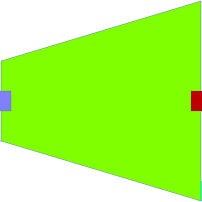
A combustion turbine, also called gas turbine, is a type of internal combustion engine. The main elements common to all gas turbines are an upstream rotating gas compressor, a combustor and a downstream turbine on the same shaft as the compressor.
In this model, the hot fluid flow is assumed steady-state and supersonic.
## Modelica component model
The equations mentioned below are implemented in the component *CombustionTurbine*, located in the *FlueGases.Machines* sub-library.
The component has 4 connectors:
- Ce: flue gases at the inlet,
- Cs: flue gases at the outlet,
- CompressorPower: compressor power input,
- MechPower: mechanical power output.

## Nomenclature
| Symbol| Description| Unit| Definition| Modelica name|
| :------------------------- | :----------------------------------------------------- | :--------------------------- | :---------------------------------- | :-------------------------------|
| \\(h\_{\mathrm{i}}\\)| Fluid specific enthalpy at the inlet| \\(\mathrm{J} / \mathrm{kg}\\) ||He|
| \\(h\_{\mathrm{is}}\\)| Fluid specific enthalpy after the isentropic expansion | \\(\mathrm{J} / \mathrm{kg}\\) ||His|
| \\(h\_{\mathrm{o}}\\)| Fluid specific enthalpy at the outlet| \\(\mathrm{J} / \mathrm{kg}\\) ||Hs|
| \\(\dot{m}\\)| Fluid mass flow rate| \\(\mathrm{kg} / \mathrm{s}\\) ||Q|
| \\(\dot{m}\_{\mathrm{cor}}\\) | Corrected mass flow rate \(mass flow rate parameter\)| \\(-\\)||Qred|
| \\(P\_{\mathrm{i}}\\)| Fluid pressure at the inlet| \\(\mathrm{Pa}\\)||Pe|
| \\(P\_{\mathrm{o}}\\)| Fluid pressure at the outlet| \\(\mathrm{Pa}\\)||Ps|
| \\(W\_{\mathrm{c}}\\)| Compressor power \(negative value\)| \\(\mathrm{W}\\)||Wcp|
| \\(W\_{\mathrm{m}}\\)| Mechanical power| \\(\mathrm{W}\\)||Wmech|
| \\(W\_{\mathrm{t}}\\)| Turbine power \(total power\)| \\(\mathrm{W}\\)||Wturb|
| \\(X\\)| Ratio between the actual and nominal expansion rate| \\(-\\)| \\(\pi / \pi\_{n}\\)|Xtau|
| \\(\eta\_{\mathrm{is}}\\)| Isentropic efficiency| \\(-\\)||is_eff|
| \\(\eta\_{\mathrm{n}}\\)| Nominal isentropic efficiency| \\(-\\)||is_eff_n|
| \\(\pi\\)| Expansion rate| \\(-\\)| \\(P\_{\mathrm{o}} / P\_{\mathrm{i}}\\)|tau|
| \\(\pi\_{\mathrm{n}}\\)| Nominal expansion rate| \\(-\\)||tau_n|
## Governing equations
### Fluid specific enthalpy at the outlet
- Validity domain:
\\(\forall h\_{\mathrm{i}}\\)
- Mathematical formulation:
$$h\_{\mathrm{o}}=h\_{\mathrm{i}}+\eta\_{\mathrm{is}} \cdot\left\(h\_{\mathrm{is}}-h\_{\mathrm{i}}\right\)$$
- Comments:
### Isentropic efficiency
- Validity domain:
\\(X>0\\)
- Mathematical formulation:
$$\eta\_{\mathrm{is}}=f\_{\eta\_{\mathrm{is}}}\(X\) \cdot \eta\_{n}$$
- Comments:
\\(f\_{\eta\_{\mathrm{is}}}\(X\)\\) is the turbine map expressed as a polynomial function of \\(X\\).
### Total turbine power
- Validity domain:
\\(\forall \dot{m}\\)
- Mathematical formulation:
$$W\_{\mathrm{t}}=\dot{m} \cdot\left\(h\_{\mathrm{i}}-h\_{\mathrm{o}}\right\)$$
- Comments:
### Mechanical power
- Validity domain:
\\(\forall \dot{m}\\)
- Mathematical formulation:
$$W\_{\mathrm{m}}=W\_{\mathrm{t}}+W\_{\mathrm{c}}$$
- Comments:
The mechanical power produced by the shaft of the electricity generator is the total turbine power minus the power used by the compressor (counted negatively).
### Mass flow rate
- Validity domain:
\\(\forall P\_{i}\\) and \\(\forall T\_{\mathrm{i}}\\)
- Mathematical formulation:
$$\dot{m}\_{\mathrm{cor}}=\frac{\dot{m} \cdot \sqrt{T\_{\mathrm{i}}}}{P\_{\mathrm{i}}}$$
- Comments:
This equation calculates the mass flow rate from the corrected mass flow rate provided by the user.
## References
El Hefni, Baligh and Bouskela, Daniel (2019). [Modeling and Simulation of Thermal Power Plants with ThermoSysPro](https://link.springer.com/book/10.1007/978-3-030-05105-1), sect. 11.4. Springer Nature Switzerland AG.
Parameters
| Type | Name | Default | Description |
|---|
| Real | A3 | 0 | X^3 coefficient of the efficiency curve |
| Real | A2 | -0.04778 | X^2 coefficient of the efficiency curve |
| Real | A1 | 0.09555 | X^1 coefficient of the efficiency curve |
| Real | A0 | 0.95223 | X^0 coefficient of the efficiency curve |
| Real | tau_n | 0.07 | Nominal expansion rate |
| Real | is_eff_n | 0.8600 | Nominal isentropic efficiency |
| Real | Qred | 0.01 | Reduced mass flow rate |
Revisions
Author

Baligh El Hefni