Information
## Copyright © EDF 2002 - 2026
## ThermoSysPro Version 4.2
This component model is documented in Sect. 9.5.5 of the ThermoSysPro book.
# NTU water heating
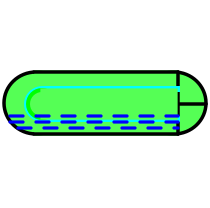
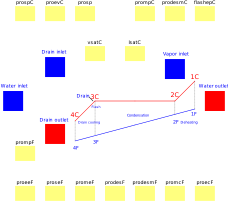
The static water heater is a two-phase shell-and-tube heat exchanger with three distinct areas. The desuperheating zone and the condensation zone are located in the upper part, and the subcooled zone is in the lower part.
In some water heaters, the condensate of the water heater located upstream from the current water heater is reinjected into the current water heater. During reinjection, part of the condensate may vaporize due to the pressure drop.
## Modelica component model
The equations mentioned below are implemented in the component *NTUWaterHeating*, located in the *WaterSteam.HeatExchangers* sub-library.
This component has 5 connectors:
- Ee: water inlet,
- Se: water outlet
- Ep: drain inlet,
- Sp: drain outlet,
- Ev: vapor inlet.

## Nomenclature
| Symbol | Description | Unit | Modelica name |
| :------------------------ | :----------------------------------------------------------------------------------------------------------------------- | :---------------------------------------- | :----------- |
|\\(c\_{p, \mathrm{c}, \text { cond }}\\) | Cold fluid specific heat capacity of the condensation zone |\\(\mathrm{J} / \mathrm{kg} / \mathrm{K}\\)| promcF.cp |
|\\(c\_{p, \mathrm{c}, \text { des }}\\) | Cold fluid specific heat capacity of the desuperheating zone | \\(\mathrm{J} / \mathrm{kg} / \mathrm{K}\\)| prodesmF.cp |
|\\(c\_{p, \text { h,des }}\\) | Hot fluid specific heat capacity of the desuperheating zone | \\(\mathrm{J} / \mathrm{kg} / \mathrm{K}\\)| prodesmC.cp |
|\\(c\_{p, d, 0}\\) | Specific heat capacity of the outlet drain | \\(\mathrm{J} / \mathrm{kg} / \mathrm{K}\\)| prospC.cp |
|\\(c\_{p, c, d}\\) | Cold fluid specific heat capacity of the subcooled zone | \\(\mathrm{J} / \mathrm{kg} / \mathrm{K}\\)| prompC.cp |
|\\(h\_{\mathrm{c}, \mathrm{i}}\\) | Cold fluid \(water\) specific enthalpy at the inlet | \\(\mathrm{J} / \mathrm{kg}\\)| Ee.h |
|\\(h\_{\mathrm{c}, \mathrm{o}}\\) | Cold fluid \(water\) specific enthalpy at the outlet | \\(\mathrm{J} / \mathrm{kg}\\)| Se.h |
|\\(h\_{\mathrm{c}, \mathrm{cond}}\\) | Cold fluid specific enthalpy at the inlet of the condensation zone | \\(\mathrm{J} / \mathrm{kg}\\) | proeC.h |
|\\(h\_{\mathrm{c}, \mathrm{des}}\\) | Cold fluid specific enthalpy at the inlet of the desuperheating zone | \\(\mathrm{J} / \mathrm{kg}\\)| prodesF.h |
|\\(h\_{\mathrm{d}, \mathrm{i}}\\) | Fluid specific enthalpy of the drain inlet | \\(\mathrm{J} / \mathrm{kg}\\)| Ep.h |
|\\(h\_{\mathrm{h}, \mathrm{i}}\\) | Hot fluid \(steam\) specific enthalpy at the inlet | \\(\mathrm{J} / \mathrm{kg}\\)| Ev.h |
|\\(h\_{\mathrm{h}, \mathrm{o}}\\) | Hot fluid \(drain\) specific enthalpy at the outlet | \\(\mathrm{J} / \mathrm{kg}\\)| Sp.h |
|\\(h\_{\mathrm{h}, \mathrm{sub}}\\) | Hot fluid specific enthalpy at the inlet of the subcooled zone | \\(\mathrm{J} / \mathrm{kg}\\)| prosp.h |
|\\(h\_{l}^{\mathrm{sat}}\\) | Hot fluid saturation enthalpy of the liquid | \\(\mathrm{J} / \mathrm{kg}\\)| lsatC.h |
|\\(h\_{\mathrm{v}}^{\mathrm{sat}}\\) | Hot fluid saturation enthalpy of the steam | \\(\mathrm{J} / \mathrm{kg}\\)| vsatC.h |
|\\(\dot{m}\_{\mathrm{c}}\\) | Cold fluid mass flow rate |\\(\mathrm{kg} / \mathrm{s}\\)| Ee.Q |
|\\(\dot{m}\_{\mathrm{h}}\\) | Hot fluid mass flow rate |\\(\mathrm{kg} / \mathrm{s}\\)| Ev.Q |
|\\(m\_{\mathrm{d}, \mathrm{i}}\\) | Mass flow rate of the input drain | \\(\mathrm{kg} / \mathrm{s}\\)| Ep.Q |
|\\(m\_{\mathrm{d}, \mathrm{o}}\\) | Mass flow rate of the output drain |\\(\mathrm{kg} / \mathrm{s}\\)| Sp.Q |
|\\(P\_{\mathrm{c}, \mathrm{i}}\\) | Cold fluid pressure at the inlet |\\(\mathrm{Pa}\\)| Ee.P |
|\\(P\_{\mathrm{c}, \mathrm{o}}\\) | Cold fluid pressure at the outlet |\\(\mathrm{Pa}\\)| Se.P |
|\\(S\_{\text {cond }}\\) | Exchange surface of the condensation zone | \\(\mathrm{m}^{2}\\)| SCondDes |
|\\(S\_{\text {des }}\\) | Exchange surface of the desuperheating zone|\\(\mathrm{m}^{2}\\)| SCondDes |
|\\(S\_{\text {liq }}\\) | Exchange surface of the subcooled zone |\\(\mathrm{m}^{2}\\)| Spurge |
|\\(T\_{\mathrm{h}, \mathrm{i}}\\) | Hot fluid \(steam\) temperature at the inlet | \\(\mathrm{K}\\)| proevC.T |
|\\(T\_{\mathrm{h}, \text { sub }}\\) | Hot fluid temperature at the inlet of the subcooled zone | \\(\mathrm{K}\\) | prosp.T |
|\\(T\_{\text {sat }}\\) | Saturation temperature of the hot fluid |\\(\mathrm{K}\\)| lsatC.T, vsatC.T |
\\(T\_{\mathrm{c}, \mathrm{i}}\\) | Cold fluid \(water\) temperature at the inlet | \\(\mathrm{K}\\)| proeeF.T |
|\\(T\_{\mathrm{c}, \mathrm{o}}\\) | Cold fluid temperature at the outlet | \\(\mathrm{K}\\)| proseF.T |
|\\(T\_{\mathrm{c}, \text { cond }}\\) | Cold fluid temperature at the inlet of the condensation zone | \\(\mathrm{K}\\) | proecF.T |
|\\(T\_{\text {c,des }}\\) | Cold fluid temperature at the inlet of the desuperheating zone | \\(\mathrm{K}\\) | prodesF.T |
|\\(W\_{\text {cond }}\\) | Thermal power exchanged in the condensation zone | \\(\mathrm{W}\\) | Wcond |
|\\(W\_{\text {des }}\\) | Thermal power exchanged in the desuperheating zone | \\(\mathrm{W}\\) | Wdes |
|\\(W\_{\text {sub }}\\) | Thermal power exchanged in the subcooled zone | \\(\mathrm{W}\\) | Wpurge |
|\\(W\_{\text {vapo }}\\) | Thermal power exchanged for the partial vaporization of the input drain | \\(\mathrm{W}\\) | Wflash |
|\\( x\_{d} \\) | Vapor mass fraction in the subcooled zone | \\(-\\) | prompC.x |
|\\( \varepsilon\_{\text {cond}} \\) | NTU effectiveness of the condensation zone | \\(-\\) | - |
|\\(\varepsilon\_{\text {d}} \\) | NTU effectiveness of the subcooled zone | \\(-\\)| - |
|\\(\varepsilon\_{\text {des}} \\) | NTU effectiveness of the desuperheating zone |\\(-\\)| - |
| \\( \Lambda \\) | Friction pressure loss coefficient for the cold fluid | \\(\mathrm{m}^{-4}\\) lambdaE |
| \\( \rho_c \\) | Cold fluid density | \\(\mathrm{kg} / \mathrm{m}^{3}\\)| rho |
## Governing equations
### Thermal power exchanged in the desuperheating zone if \\(h\_{\mathrm{h}, \mathrm{i}}>h\_{\mathrm{v}}^{\mathrm{sat}}\\)
- Validity domain:
\\(\dot{m}\_{\mathrm{h}}>0\\) and \\(\dot{m}\_{\mathrm{c}}>0\\)
- Mathematical formulation:
$$W\_{\mathrm{des}} =\min \left\(\dot{m}\_{\mathrm{h}} \cdot c\_{p, \mathrm{h}, \mathrm{des}}, \dot{m}\_{\mathrm{c}} \cdot c\_{p, \mathrm{c}, \text { des }}\right\) \cdot \varepsilon\_{\text {des }} \cdot\left\(T\_{\mathrm{h}, \mathrm{i}}-T\_{\mathrm{c}, \text { des }}\right\)$$
- Comments:
These equations are used only if \\(h\_{\mathrm{h}, \mathrm{i}}>h\_{\mathrm{v}}^{\mathrm{sat}}\\). If not \(i.e., for \\(\left.h\_{\mathrm{h}, \mathrm{i}} \leq h\_{\mathrm{v}}^{\mathrm{sat}}\right\),\\) then \\(W\_{\mathrm{des}}=0 .\\) The objective of these equations is to compute the desuperheating power \\(W\_{\text {des}} \\) and the specific enthalpy \\(h\_{\mathrm{c}, \mathrm{o}}\\) of the cold fluid at the outlet.
### Thermal power exchanged in the condensation zone if \\(h\_{\mathrm{h}, \mathrm{i}}>h\_{\mathrm{v}}^{\mathrm{sat}}\\)
- Validity domain:
\\(\dot{m}\_{\mathrm{h}}>0\\) and \\(\dot{m}\_{\mathrm{c}}>0\\)
- Mathematical formulation:
$$W\_{\text {cond }}=\dot{m}\_{\mathrm{h}} \cdot\left\(h\_{\mathrm{v}}^{\mathrm{sat}}-h\_{l}^{\mathrm{sat}}\right\)+W\_{\mathrm{vapo}} = \dot{m}\_{\mathrm{c}} \cdot c\_{p, \mathrm{c}, \text { cond }} \cdot \varepsilon\_{\text {cond }} \cdot\left\(T\_{\mathrm{sat}}-T\_{\mathrm{c}, \mathrm{cond}}\right\)$$
- Comments:
These equations are used only if \\(h\_{\mathrm{h}, \mathrm{i}}>h\_{\mathrm{v}}^{\text {sat }}\(\mathrm{i.e.},\\) presence of a desuperheating zone\). The objective of these equations is to compute the specific enthalpy \\(h\_{\mathrm{c}, \text { des }}\\) of the cold fluid at the outlet of this zone and the mass flow rate \\(\dot{m}\_{\mathrm{h}}\\) of the hot fluid (steam) at the input.
### Thermal power exchanged in the condensation zone if \\(h\_{\mathrm{h}, \mathrm{i}} \leq h\_{\mathrm{v}}^{\text {sat }}\\)
- Validity domain:
\\(\dot{m}\_{\mathrm{h}}>0\\) and \\(\dot{m}\_{\mathrm{c}}>0\\)
- Mathematical formulation:
$$W\_{\text {cond }} = \dot{m}\_{\mathrm{c}} \cdot c\_{p, \mathrm{c}, \text { cond }} \cdot \varepsilon\_{\text {cond }} \cdot\left\(T\_{\mathrm{sat}}-T\_{\mathrm{c}, \mathrm{cond}}\right\)$$
- Comments:
These equations are used only if \\(h\_{\mathrm{h}, \mathrm{i}} \leq h\_{\mathrm{v}}^{\text {sat }}\\) \(i.e., absence of the desuperheating zone\). The objective of these equations is to compute the specific enthalpy \\(h\_{\mathrm{c}, \text { cond }}\\) of the cold fluid at the outlet of this zone and the mass flow rate \\(m\_{\mathrm{h}}\\) of the hot fluid \(steam\) at the input.
### Thermal power exchanged in the drain by partial vaporization (flash)
- Validity domain:
\\(\dot{m}\_{\mathrm{d}, \mathrm{i}} \geq 0\\)
- Mathematical formulation:
$$W\_{\mathrm{vapo}}=\dot{m}\_{\mathrm{d}, \mathrm{i}} \cdot x\_{\mathrm{d}} \cdot\left\(h\_{\mathrm{v}}^{\mathrm{sat}}-h\_{l}^{\mathrm{sat}}\right\)$$
- Comments:
This equation can also be written as \\(W\_{\mathrm{vapo}}=\dot{m}\_{\mathrm{d}, \mathrm{i}} \cdot\left\(h\_{\mathrm{d}, \mathrm{i}}-h\_{l}^{\mathrm{sat}}\right\)\\) \\(\operatorname{since}\\) \\(\dot{m}\_{\mathrm{d}, \mathrm{i}} \cdot h\_{\mathrm{d}, \mathrm{i}}=\dot{m}\_{\mathrm{d}, \mathrm{i}} \cdot x\_{\mathrm{d}} \cdot h\_{\mathrm{v}}^{\mathrm{sat}}+\dot{m}\_{\mathrm{d}, \mathrm{i}} \cdot\left\(1-x\_{\mathrm{d}}\right\) \cdot h\_{l}^{\mathrm{sat}}\\).
### Energy balance equation at the inlet of the subcooled zone (mixing of the hot fluid with the drain fluid) if \\(x\_{\mathrm{d}}=0\\)
- Validity domain:
\\(\dot{m}\_{\mathrm{d}, \mathrm{o}} \neq 0\\)
- Mathematical formulation:
$$\dot{m}\_{\mathrm{d}, \mathrm{o}} \cdot h\_{\mathrm{h}, \mathrm{sub}}=\dot{m}\_{\mathrm{h}} \cdot h\_{l}^{\mathrm{sat}}+\dot{m}\_{\mathrm{d}, \mathrm{i}} \cdot h\_{\mathrm{d}, \mathrm{i}}$$
- Comments:
The objective of this equation is to compute the specific enthalpy \\(h\_{\mathrm{h}, \text { sub }}\\) at the inlet of the subcooled zone for the hot fluid. If \\(x\_{\mathrm{d}}>0,\\) then \\(h\_{\mathrm{h}, \text { sub }}=h\_{l}^{\mathrm{sat}}\\).
### Energy balance equation for subcooled zone (drain cooling) if \\(S\_{\text {liq }}>0\\)
- Validity domain:
\\(\dot{m}\_{\mathrm{c}}>0\\) and \\(\dot{m}\_{\mathrm{d}, \mathrm{o}}>0\\)
- Mathematical formulation:
$$ W\_{\mathrm{sub}} = \min \left\(\dot{m}\_{\mathrm{d}, \mathrm{o}} \cdot c\_{p, \mathrm{d}, 0}, \dot{m}\_{\mathrm{c}} \cdot c\_{p, \mathrm{c}, \mathrm{d}}\right\) \cdot \varepsilon\_{\mathrm{d}} \cdot\left\(T\_{\mathrm{h}, \mathrm{sub}}-T\_{\mathrm{c}, \mathrm{i}}\right\) $$
- Comments:
If \\(S\_{\mathrm{liq}}=0,\\) then \\(W\_{\mathrm{sub}}=0\\) and
\\(h\_{\mathrm{h}, \mathrm{o}}=h\_{\mathrm{h}, \text { sub }}\\).
### Mass balance equation for the hot fluid (mixing of the hot fluid with the drain fluid)
- Validity domain:
\\(\dot{m}\_{\mathrm{h}}>0\\) and \\(\dot{m}\_{\mathrm{d}, \mathrm{i}} \geq 0\\)
- Mathematical formulation:
$$\dot{m}\_{\mathrm{d}, \mathrm{o}}=\dot{m}\_{\mathrm{h}}+\dot{m}\_{\mathrm{d}, \mathrm{i}}$$
- Comments:
### Momentum balance equation for the cold fluid (pressure loss equation in the water pipes)
- Validity domain:
\\(\forall \dot{m}\_{\mathrm{c}}\\)
- Mathematical formulation:
$$P\_{\mathrm{c}, \mathrm{i}}-P\_{\mathrm{c}, \mathrm{o}} = \Lambda \cdot \frac{\dot{m}\_{\mathrm{c}} \cdot \dot{m}\_{\mathrm{c}}}{\rho\_{\mathrm{c}}}$$
- Comments:
Only pressure losses due friction are taken into account.
## References
El Hefni, Baligh and Bouskela, Daniel (2019). [Modeling and Simulation of Thermal Power Plants with ThermoSysPro](https://link.springer.com/book/10.1007/978-3-030-05105-1), sect. 9.5.5. Springer Nature Switzerland AG.