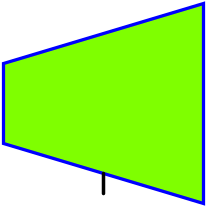
modelStodolaTurbine
Multistage turbine group using Stodola's ellipse
Information
## Copyright © EDF 2002 - 2026
## ThermoSysPro Version 4.2
This component model is documented in Sect. 10.2 of the ThermoSysPro book.
# Stodola turbine
The steam turbine transforms the steam thermal energy into mechanical energy
following the Rankine cycle. A multistage turbine is composed of a group of
stages that uses wet or dry steam.
The Stodola turbine is a quasi-static model, composed of a multistage steam turbine and a nozzle. Stodola's cone law is used to compute the dependence of extraction pressures with the fluid flow.
The following assumptions are made:
- the fluid speed is subsonic.
- the dynamic response of the turbine is faster than the network queries (inertia is neglected).
- the flow is supercritical or subcritical at the inlet and outlet.
## Modelica component model
The equations mentioned below are implemented in the component *StodolaTurbine*, located in the *WaterSteam.HeatExchangers* sub-library.
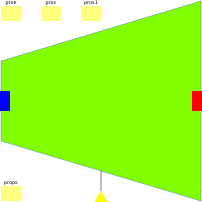
This component has 4 connectors:
- Ce: fluid inlet,
- Cs: fluid outlet,
- M: mechanical torque,
- P: mechanical power.

## Nomenclature
| Symbol| Description| Unit| Definition| Modelica name |
| :------------------------------------ | :------------------------------------------------- | :--------------------------- | :---------------------------------------------------------- | -----------------|
| \\(A\_{\mathrm{nz}}\\)| Nozzle area| \\(\mathrm{m}^{2}\\)|| - |
| \\(C\_{\mathrm{s}}\\)| Stodola’s ellipse coefficient| \\(-\\)|| Cst |
| \\(h\_{\mathrm{i}}\\)| Fluid specific enthalpy at the inlet| \\(\mathrm{J} / \mathrm{kg}\\) || Ce.h |
| \\(h\_{\mathrm{is}}\\)| Fluid specific enthalpy after isentropic expansion | \\(\mathrm{J} / \mathrm{kg}\\) || His |
| \\(h\_{\mathrm{o}}\\)| Fluid specific enthalpy at the outlet| \\(\mathrm{J} / \mathrm{kg}\\) || Cs.h |
| \\(m\\)| Fluid mass flow rate| \\(\mathrm{kg} / \mathrm{s}\\) || Q |
| \\(P\_{\mathrm{i}}\\)| Fluid pressure at the inlet| \\(\mathrm{Pa}\\)|| Pe |
| \\(P\_{\mathrm{o}}\\)| Fluid pressure at the outlet| \\(\mathrm{Pa}\\)|| Ps |
| \\(T\_{\mathrm{i}}\\)| Fluid temperature at the inlet| \\(\mathrm{K}\\)|| Te |
| \\(v\_{\mathrm{o}}\\)| Fluid velocity at the outlet| \\(\mathrm{m} / \mathrm{s}\\)| \\(\frac{\dot{m}}{\rho\_{\mathrm{o}} \cdot A\_{\mathrm{nz}}}\\) | Ts |
| \\(W\\)| Mechanical power produced by the turbine| \\(\mathrm{W}\\)|| W |
| \\(W\_{\text {fric }}\\)| Power losses due to hydrodynamic friction| \\(\%\\)|| W_fric |
| \\(x\_{\mathrm{i}}\\)| Vapor mass fraction at the inlet| \\(-\\)|| proe.x |
| \\(x\_{\mathrm{o}}\\)| Vapor mass fraction at the outlet| \\(-\\)|| pros.x |
| \\(\eta\_{\mathrm{is}}\\)| Isentropic efficiency for the dry steam| \\(-\\)|| eta_is |
| \\(\eta\_{\mathrm{is}}^{\mathrm{wet}}\\) | Isentropic efficiency for wet steam| \\(-\\)|| eta_is_wet |
| \\(\eta\_{\mathrm{nz}}\\)| Nozzle efficiency| \\(-\\)|| eta_nz |
| \\(\eta\_{\mathrm{sta}}\\)| Efficiency to account for kinetic losses| \\(-\\)|| eta_stato |
## Governing equations
### Stodola’s ellipse law mass flow rate for subcritical flow
- Validity domain:
\\(\forall \dot{m}\\) and \\(x\_{\mathrm{i}}>0\\)
- Mathematical formulation:
$$\dot{m}=C\_{\mathrm{s}} \cdot \sqrt{\frac{P\_{\mathrm{i}}^{2}-P\_{\mathrm{o}}^{2}}{x\_{\mathrm{i}} \cdot T\_{\mathrm{i}}}}$$
- Comments:
### Stodola’s ellipse law mass flow rate for supercritical flow
- Validity domain:
\\(\forall \dot{m}\\)
- Mathematical formulation:
$$\dot{m}=C\_{\mathrm{s}} \cdot \sqrt{\frac{P\_{\mathrm{i}}^{2}-P\_{\mathrm{o}}^{2}}{T\_{\mathrm{i}}}}$$
- Comments:
### Fluid specific enthalpy at the outlet
- Validity domain:
everywhere
- Mathematical formulation:
$$h\_{\mathrm{o}}=h\_{\mathrm{i}}+\eta\_{\mathrm{is}} \cdot x\_{\mathrm{m}} \cdot\left\(h\_{\mathrm{is}}-h\_{\mathrm{i}}\right\)+\frac{\left\(1-\eta\_{\mathrm{nz}}\right\) \cdot v\_{\mathrm{o}}^{2}}{2}$$
- Comments:
The last term of the equation corresponds to the kinetic energy of the steam at the outlet. The nozzle efficiency \\(\eta\_{\mathrm{nz}}\\) is less than unity for a turbine with nozzle and equal to unity for a turbine without nozzle.
### Energy balance equation (mechanical power produced by the turbine)
- Validity domain:
\\(\forall \dot{m}\\)
- Mathematical formulation:
$$W=\eta\_{\text {sta }} \cdot \dot{m} \cdot\left\(h\_{\mathrm{i}}-h\_{\mathrm{o}}\right\) \cdot\left\(1-\frac{W\_{\text {fric }}}{100}\right\)$$
## References
El Hefni, Baligh and Bouskela, Daniel (2019). [Modeling and Simulation of Thermal Power Plants with ThermoSysPro](https://link.springer.com/book/10.1007/978-3-030-05105-1), sect. 10.2. Springer Nature Switzerland AG.
Parameters
| Type | Name | Default | Description |
|---|
| Real | Cst | 1.e7 | Stodola's ellipse coefficient |
| Real | W_fric | 0.0 | Power losses due to hydrodynamic friction (percent) |
| Real | eta_stato | 1.0 | Efficiency to account for cinetic losses (<= 1) (s.u.) |
| Units.SI.Area | area_nz | 1 | Nozzle area |
| Real | eta_nz | 1.0 | Nozzle efficency (eta_nz < 1 - turbine with nozzle - eta_nz = 1 - turbine without nozzle) |
| Units.SI.MassFlowRate | Qmax | 1 | Maximum mass flow through the turbine |
| Real | eta_is_nom | 0.8 | Nominal isentropic efficiency |
| Real | eta_is_min | 0.35 | Minimum isentropic efficiency |
| Real | a | -1.3889 | x^2 coefficient of the isentropic efficiency characteristics eta_is=f(Q/Qmax) |
| Real | b | 2.6944 | x coefficient of the isentropic efficiency characteristics eta_is=f(Q/Qmax) |
| Real | c | -0.5056 | Constant coefficient of the isentropic efficiency characteristics eta_is=f(Q/Qmax) |
| Integer | fluid | 1 | 1: water/steam - 2: C3H3F5 |
| Integer | mode_e | 0 | IF97 region before expansion. 1:liquid - 2:steam - 4:saturation line - 0:automatic |
| Integer | mode_s | 0 | IF97 region after expansion. 1:liquid - 2:steam - 4:saturation line - 0:automatic |
| Integer | mode_ps | 0 | IF97 region after isentropic expansion. 1:liquid - 2:steam - 4:saturation line - 0:automatic |
Revisions
Authors

Daniel Bouskela
Baligh El Hefni