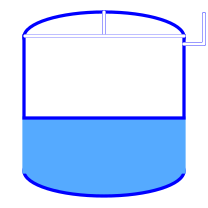
modelPressurizer
Pressurizer
Information
## Copyright © EDF 2002 - 2026
## ThermoSysPro Version 4.2
This component model is documented in Sect. 14.3 of the ThermoSysPro book.
# Pressurizer
The pressurizer is used in water reactors to control the pressure inside the primary system, so that the reactor coolant remains always liquid.
The pressure of the two-phase fluid inside the pressurizer is controlled by the temperature.
To that end, the pressurizer is equipped with electric heating rods at the bottom, and cooling spray tubes at the top .
It is also equipped with several safety valves.
Following assumptions are made:
- the pressurizer is always operating in two-phase conditions.
- pressure losses are neglected.
- the liquid and steam phases are not necessarily in thermal equilibrium, but always in pressure equilibrium.
## Modelica component model
The equations mentioned below are implemented in the component *Pressurizer*, located in the *WaterSteam.Volumes* sub-library.
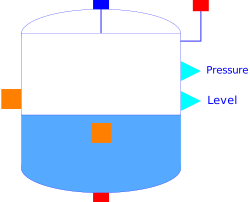
This component has 6 connectors:
- Cas: water inlet,
- Cs: steam outlet,
- Ca: thermal input to the wall,
- Cc: thermal input to the liquid,
- Cex: water outlet,
- yLevel: water level output.

## Nomenclature
| Symbol| Description| Unit| Definition| Modelica name |
| :-------------------------------- | :--------------------------------------------------------------------------------------- | :------------------------------------------- | :----------------------------------------------------------------------------------------------------------- | :----------- |
| \\(A\_{\mathrm{e}}\\)| External pressurizer surface| \\(\mathrm{m}^{2}\\)|| Ae |
| \\(A\_{\mathrm{lw}}\\)| Heat exchange surface between the liquid phase and the wall| \\(\mathrm{m}^{2}\\)| \\(2 \cdot \pi \cdot R \cdot z\_{l}\\)| Slpin |
| \\(A\_{\mathrm{p}}\\)| Pressurizer cross-sectional area| \\(\mathrm{m}^{2}\\)| \\(\pi \cdot \mathrm{R}^{2}\\)| Ap |
| \\(A\_{\mathrm{vw}}\\)| Heat exchange surface between the steam phase and the wall| \\(\mathrm{m}^{2}\\)| \\(2 \cdot \pi \cdot R \cdot\left\(\frac{\mathrm{V}}{\mathrm{A}\_{\mathrm{p}}}-\mathrm{z}\_{l}\right\)\\)| Svpin |
| \\(c\_{\mathrm{p}, \mathrm{w}}\\)| Specific heat capacity of the wall| \\(\mathrm{J} / \mathrm{kg} / \mathrm{K}\\)|| cpp |
| \\(C\_{\text {cond }}\\)| Condensation rate| \\(\mathrm{s}^{-1}\\)|| Ccond |
| \\(C\_{\text {evap }}\\)| Evaporation rate| \\(\mathrm{s}^{-1}\\)|| Cevap |
| \\(g\\)| Acceleration due to gravity| \\(\mathrm{m} / \mathrm{s}^{2}\\)|| g |
| \\(h\_{l}\\)| Specific enthalpy of the liquid phase in the pressurizer| \\(\mathrm{J} / \mathrm{kg}\\)|| hl |
| \\(h\_{l, \mathrm{i}}\\)| Specific enthalpy of the liquid at the inlet of the pressurizer| \\(\mathrm{J} / \mathrm{kg}\\)|| Cas.h |
| \\(h\_{l,0}\\)| Specific enthalpy of the liquid at the outlet of the pressurizer| \\(\mathrm{J} / \mathrm{kg}\\)|| Cex.h |
| \\(h\_{l}^{\text {sat }}\\)| Saturation enthalpy of the liquid in the pressurizer| \\(\mathrm{J} / \mathrm{kg}\\)|| hls |
| \\(h\_{\mathrm{v}}\\)| Specific enthalpy of the steam phase in the pressurizer| \\(\mathrm{J} / \mathrm{kg}\\)|| hv |
| \\(h\_{\mathrm{v}, \mathrm{o}}\\)| Specific enthalpy of the steam at the outlet of the pressurizer| \\(\mathrm{J} / \mathrm{kg}\\)|| Cs.h |
| \\(h\_{\mathrm{v}}^{\mathrm{sat}}\\) | Saturation enthalpy of the steam in the pressurizer| \\(\mathrm{J} / \mathrm{kg}\\)|| hvs |
| \\(K\_{\mathrm{lw}}\\)| Convective heat exchange coefficient between the liquid and the wall of the pressurizer| \\(\mathrm{W} / \mathrm{m}^{2} / \mathrm{K}\\) || Klp |
| \\(K\_{\mathrm{vl}}\\)| Convective heat exchange coefficient between the liquid and the steam in the pressurizer | \\(\mathrm{W} / \mathrm{m}^{2} / \mathrm{K}\\) || Klv |
| \\(K\_{\mathrm{vw}}\\)| Convective heat exchange coefficient between the steam and the wall of the pressurizer| \\(\mathrm{W} / \mathrm{m}^{2} / \mathrm{K}\\) || Kvp |
| \\(K\_{\mathrm{wa}}\\)| Convective heat exchange coefficient between the wall of the pressurizer and the ambient | \\(\mathrm{W} / \mathrm{m}^{2} / \mathrm{K}\\) || Kpa |
| \\(\dot{m}\_{\text {evap }}\\)| Evaporation mass flow rate inside the pressurizer| \\(\mathrm{kg} / \mathrm{s}\\)|| Qevap |
| \\(\dot{m}\_{l, \mathrm{i}}\\)| Mass flow rate of the liquid at the inlet of the pressurizer| \\(\mathrm{kg} / \mathrm{s}\\)|| Cas.Q |
| \\(\dot{m}\_{l, \mathrm{o}}\\)| Mass flow rate of the liquid at the outlet of the pressurizer| \\(\mathrm{kg} / \mathrm{s}\\)|| Cex.Q |
| \\(\dot{m}\_{\mathrm{v}}\\)| Mass flow rate of the steam at the outlet of the pressurizer| \\(\mathrm{kg} / \mathrm{s}\\)|| Cs.Q |
| \\(M\_{\mathrm{w}}\\)| Mass of the wall of the pressurizer| \\(\mathrm{kg}\\)|| Mp |
| \\(P\\)| Pressure inside the pressurizer| \\(\mathrm{Pa}\\)|| P |
| \\(P\_{\mathrm{b}}\\)| Fluid pressure at the bottom of the pressurizer| \\(\mathrm{Pa}\\)| \\(P+\frac{g}{A\_{\mathrm{p}}} \cdot\left\(\rho\_{l} \cdot V\_{l}+\rho\_{\mathrm{v}} \cdot V\_{\mathrm{v}}\right\)\\) | Pfond |
| \\(R\\)| Pressurizer cross-sectional radius| \\(\mathrm{m}\\)|| Rp |
| \\(T\_{\mathrm{a}}\\)| Ambient temperature| \\(\mathrm{K}\\)|| Ta |
| \\(T\_{l}\\)| Liquid temperature in the pressurizer| \\(\mathrm{K}\\)|| Tl |
| \\(T\_{\mathrm{v}}\\)| Steam temperature in the pressurizer| \\(\mathrm{K}\\)|| Tv |
| \\(T\_{\mathrm{w}}\\)| Wall temperature of the pressurizer| \\(\mathrm{K}\\)|| Tp |
| \\(V\\)| Pressurizer volume| \\(\mathrm{m}^{3}\\)|| V |
| \\(V\_{l}\\)| Volume of the liquid in the pressurizer| \\(\mathrm{m}^{3}\\)| \\(A\_{p} \cdot z\_{l}\\)| Vl |
| \\(V\_{\mathrm{v}}\\)| Volume of the steam in the pressurizer| \\(\mathrm{m}^{3}\\)| \\(V-V\_{l}\\)| Vv |
| \\(W\_{\text {eh }}\\)| Power released by the electrical heaters| \\(\mathrm{W}\\)|| Wch |
| \\(W\_{\mathrm{lw}}\\)| Power exchanged from the liquid to the pressurizer wall| \\(\mathrm{W}\\)|| Wpl |
| \\(W\_{\mathrm{vl}}\\)| Power exchanged from the steam to the liquid| \\(\mathrm{W}\\)|| Wlv |
| \\(W\_{\mathrm{vw}}\\)| Power exchanged from the steam to the pressurizer wall| \\(\mathrm{W}\\)|| Wpv |
| \\(W\_{\mathrm{wa}}\\)| Power exchanged from the pressurizer wall to the ambient| \\(\mathrm{W}\\)|| Wpa |
| \\(y\\)| Liquid level expressed as a percent of the scale of level measure| \\(\%\\)| \\(0 \leq y \leq 1\\)| y |
| \\(z\_{l}\\)| Liquid level inside the pressurizer for the controller: water level + margin| \\(\mathrm{m}\\)| \\(z\_{\mathrm{m}} \cdot y+\frac{\frac{V}{A\_{\mathrm{p}}}-z\_{\mathrm{m}}}{2}\\)| Zl |
| \\(z\_{\mathrm{m}}\\)| Scale of level measure| \\(\mathrm{m}\\)|| Zm |
| \\(\rho\_{l}\\)| Density of the liquid inside the pressurizer| \\(\mathrm{kg} / \mathrm{m}^{3}\\)|| rhol |
| \\(\rho\_{\mathrm{v}}\\)| Density of the steam inside the pressurizer| \\(\mathrm{kg} / \mathrm{m}^{3}\\)|| rhov |
## Governing equations
### Dynamic mass balance equation for the liquid phase
- Validity domain:
\\(\forall \dot{m}\\) and \\(0<V\_{l}<V\\)
- Mathematical formulation:
$$\rho\_{l} \cdot \frac{\mathrm{d} V\_{l}}{\mathrm{d} t}+V\_{l}\left[\left\(\frac{\partial \rho\_{l}}{\partial P}\right\)\_{h} \cdot \frac{\mathrm{d} P}{\mathrm{d} t}+\left\(\frac{\partial \rho\_{l}}{\partial h}\right\)\_{P} \cdot \frac{\mathrm{d} h\_{l}}{\mathrm{d} t}\right]=\dot{m}\_{l, \mathrm{i}}-\dot{m}\_{l, \mathrm{o}}+\dot{m}\_{\mathrm{cond}}-\dot{m}\_{\mathrm{evap}}$$
### Dynamic mass balance equation for the steam phase
- Validity domain:
\\(\forall \dot{m}\\) and \\(0<V\_{v}<V\\)
- Mathematical formulation:
$$\rho\_{v} \cdot \frac{d V\_{v}}{d t}+V\_{v} \cdot\left[\left\(\frac{\partial \rho\_{v}}{\partial P}\right\)\_{h} \cdot \frac{d P}{d t}+\left\(\frac{\partial \rho\_{v}}{\partial h}\right\)\_{P} \cdot \frac{d h\_{v}}{d t}\right] =\dot{m}\_{\text {evap}}-\dot{m}\_{v}-\dot{m}\_{\text {cond}}$$
### Dynamic energy balance equation for the liquid phase
- Validity domain:
\\(\forall \dot{m}\\) and \\(0<V\_{l}<V\\)
- Mathematical formulation:
```eval_rst
.. math::
V_{l} \cdot\left(\rho_{l} \cdot \frac{\mathrm{d} h_{l}}{\mathrm{d} t}-\frac{\mathrm{d} P}{\mathrm{d} t}\right)
& =\left(\dot{m}_{l, \mathrm{i}}+\dot{m}_{\mathrm{cond}}\right) \cdot\left(h_{l}^{\mathrm{sat}}-h_{l}\right) \\ &
-\dot{m}_{\mathrm{evap}} \cdot\left(h_{\mathrm{v}}^{\mathrm{sat}}-h_{l}\right) \\
& -\dot{m}_{l, \mathrm{o}} \cdot\left(h_{l, \mathrm{o}}-h_{l}\right) \\ & +W_{\mathrm{vl}}-W_{\mathrm{lw}}+W_{\mathrm{eh}}
```
- Comments:
The term \\(\dot{m}\_{l \mathrm{i}, \mathrm{i}} \cdot\left\(h\_{l}^{\text {sat }}-h\_{l}\right\)\\) accounts for the fact that the spray is first heated to saturated liquid by contact with the steam inside the pressurizer. The saturated liquid is then mixed with the liquid inside the pressurizer.
### Dynamic energy balance equation for the steam phase
- Validity domain:
\\(\forall \dot{m}\\) and \\(0<V\_{\mathrm{v}}<V\\)
- Mathematical formulation:
$$ V_{\mathrm{v}} \cdot\left(\rho_{\mathrm{v}} \cdot \frac{\mathrm{d} h_{\mathrm{v}}}{\mathrm{d} t}-\frac{\mathrm{d} P}{\mathrm{d} t}\right) =\dot{m}_{\text{evap }} \cdot\left(h_{\mathrm{v}}^{\text{sat }}-h_{\mathrm{v}}\right) \\ -\dot{m}_{\text{cond }} \cdot\left(h_{l}^{\text{sat }}-h_{\mathrm{v}}\right) \\ -\dot{m}_{l, \mathrm{i}} \cdot\left(h_{l}^{\text{sat }}-h_{l, \mathrm{i}}\right) \\ -\dot{m}_{\mathrm{v}} \cdot\left(h_{\mathrm{v}, \mathrm{o}}-h_{\mathrm{v}}\right)-W_{\mathrm{v} }-W_{\mathrm{vw}}$$
- Comments:
The term \\(\dot{m}\_{l, \mathrm{i}} \cdot\left\(h\_{l}^{\text {sat }}-h\_{l, \mathrm{i}}\right\)\\) accounts for the fact that the spray extracts heat from the steam inside the pressurizer and turns to saturated liquid.
### Energy accumulation in the wall
- Validity domain:
\\(\forall T\_{\mathrm{w}}\\)
- Mathematical formulation:
$$M\_{\mathrm{w}} \cdot c\_{\mathrm{p}, \mathrm{w}} \cdot \frac{\mathrm{d} T\_{\mathrm{w}}}{\mathrm{d} t}=W\_{\mathrm{lw}}+W\_{\mathrm{vw}}+W\_{\mathrm{aw}}$$
### Power exchange between the steam phase and the liquid phase
- Validity domain:
\\(\forall T\_{\mathrm{v}}\\) and \\(\forall T\_{l}\\)
- Mathematical formulation:
$$W\_{\mathrm{vl}}=K\_{\mathrm{vl}} \cdot A\_{\mathrm{p}} \cdot\left\(T\_{\mathrm{v}}-T\_{l}\right\)$$
### Power exchange between the liquid and the pressurizer wall
- Validity domain:
\\(\forall T\_{l}\\) and \\(\forall T\_{\mathrm{w}}\\)
- Mathematical formulation:
$$W\_{\mathrm{lw}}=K\_{\mathrm{lw}} \cdot A\_{l} \cdot\left\(T\_{l}-T\_{\mathrm{w}}\right\)$$
### Power exchange between the steam and the pressurizer wall
- Validity domain:
\\(\forall T\_{\mathrm{v}}\\) and \\(\forall T\_{\mathrm{w}}\\)
- Mathematical formulation:
$$W\_{\mathrm{vw}}=K\_{\mathrm{vw}} \cdot A\_{\mathrm{v}} \cdot\left\(T\_{\mathrm{v}}-T\_{\mathrm{w}}\right\)$$
### Power exchange between the pressurizer wall and the ambient
- Validity domain:
\\(\forall T\_{\mathrm{w}}\\) and \\(\forall T\_{\mathrm{a}}\\)
- Mathematical formulation:
$$W\_{\mathrm{wa}}=K\_{\mathrm{wa}} \cdot A\_{\mathrm{e}} \cdot\left\(T\_{\mathrm{w}}-T\_{\mathrm{a}}\right\)$$
### Condensation mass flow rate
- Mathematical formulation:
$$\dot{m}\_{\text {cond }}=C\_{\text {cond }} \cdot \rho\_{\mathrm{v}} \cdot V\_{\mathrm{v}} \cdot \frac{h\_{\mathrm{v}}^{\mathrm{sat}}-h\_{\mathrm{v}}}{h\_{\mathrm{v}}^{\mathrm{sat}}-h\_{l}^{\mathrm{sat}}}$$
### Evaporation mass flow rate
- Mathematical formulation:
$$\dot{m}\_{\text {evap }}=C\_{\text {evap }} \cdot \rho\_{l} \cdot V\_{l} \cdot \frac{h\_{l}-h\_{l}^{\text {sat }}}{h\_{v}^{\text {sat }}-h\_{l}^{\text {sat }}}$$
## References
El Hefni, Baligh and Bouskela, Daniel (2019). [Modeling and Simulation of Thermal Power Plants with ThermoSysPro](https://link.springer.com/book/10.1007/978-3-030-05105-1), sect. 14.3. Springer Nature Switzerland AG.
Revisions
Authors

Daniel Bouskela
Baligh El Hefni