modelHeatingGenerationCharline
Information
HeatingLoadCharline
1. Purpose of model
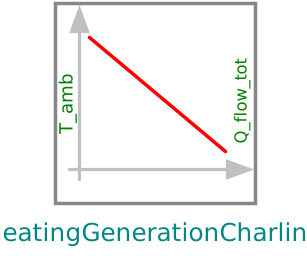
This model calculates the heat demand depending on the ambient temperature. Different characterisitic lines can be choosen (e.g. from Hamburg or Berlin). These lines consinst of a characterstic behaviour for cold days and a characteristic load chart for warm days.
A linear dependency between ambient temperature and heat production/demand is assumed. This dependency can be adjusted with the following features:
- Offset: use for fine tuning of heat output by multiplying the linear-output by a known daily offset value.
- Weekend: use to generate a change between week and weekend demand (for instance if lower demand during weekends is expected)
- Summer day: use to give an alternative (non-linear) profile in summer periods (i.e. periods where the heat output goes bellow the summer cap-line)
Offset values and Characteristic Lines are just examples of use. These values should be adapted according to the modeled system.
2. Level of detail, physical effects considered, and physical insight
The model calculates the heat load for warm days and cold days with two different formulas - the formula for 'cold days' and for 'warm days'. Both formulas can be superimposed with a damping ratio for the weekend ('Damping_Weekend') to reduce the weekend load if the Boolean 'weekend_On' is set to 'true'.
3. Limits of validity
4. Interfaces
T_amb: Input of ambient temperature
Q_flow: calculated heat demand output
5. Nomenclature
6. Governing Equations
Cold Days:
In the formula for the calculation of the heat demand on cold days (WinterDay-formula) the heat demand is lineraly dependent on the ambient temperature. Herefore the slope and the axis intercept of the characteristic linear function can be varied. Furthermore, if the Boolean 'offsetOn' is set to 'true, the heat demand is superimposed with a typical daily profile.
Warm Days:
For warm days the heat demand is independent of the ambient temperature. If the Boolean 'SummerDayTypicalHeatLoadCharLine' is set to 'true, a typical heat load profile for summer days is added to the minimum load such that the load depends on the day time. If it is set to 'false' the load is constant and equal to the minimum load.
Q_flow:
The output for the heat demand will always be the higher value of the two ways of calculating the head demand (warm days/cold days).
7. Remarks for Usage
8. Validation
9. References
5. Version History
Model created by Oliver Schülting and Ricardo Peniche, 2015
Parameters
| Type | Name | Default | Description |
|---|---|---|---|
| HeatDemandPrediction.HeatingDemandCharacteristic.CharLineHeatDemand | CharLine | Choose City's Characteristic Line | |
| Real | Damping_Weekend | 1 | Damping ratio for heat load at weekends (between 0 and 1) |
| TransiEnt.Basics.Types.TypeOfWeekday | BeginWeekday | 2 | Weekday on which simulation begins |
| Real | TransitionDuration | 5 | |
| Boolean | offsetOn | true | if 'true', the heat demand is sumperimposed with a daily profile on cold days |
| Boolean | weekendOn | true | if 'true', the heat demand on the weekend is damped by the constant factor 'Damping_Weekend' |
| Boolean | SummerDayTypicalHeatLoadCharLine | true | if true, on warm days a typical heat load profile is added to the minimum load on summer days - if 'false' the load on warm days is constant (=minimum load) |
Connectors
| Type | Name | Default | Description |
|---|---|---|---|
| TransiEnt.Basics.Interfaces.General.TemperatureCelsiusIn | T_amb | Ambient temperature in Celsius | |
| Basics.Interfaces.Thermal.HeatFlowRateOut | Q_flow | Heat flow rate input |
Components
| Type | Name | Default | Description |
|---|---|---|---|
| Real | m | CharLine.m | |
| Real | c | CharLine.c | |
| Real | a | CharLine.a | |
| Real | SummerDayProfile | ||
| Modelica.Units.SI.Heat | Q_dem | ||
| Real | offset | ||
| Basics.Tables.GenericDataTable | SummerDayTypicalHeatLoad | ||
| Basics.Blocks.Sources.WeekendPulse_Trapezoid | weekendPulse | ||
| Basics.Tables.GenericDataTable | OffsetvalueDailyprofile | ||
| Modelica.Blocks.Sources.Trapezoid | hour_of_day |