modelFreeConvectionHeatTransfer_Gas
Information
1. Purpose of model
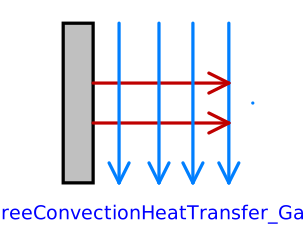
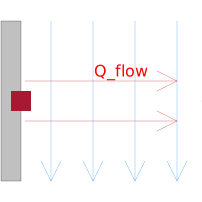
This is a model of linear heat convection, e.g., the heat transfer between a plate and the surrounding air; see also: ConvectiveResistor. It may be used for complicated solid geometries and fluid flow over the solid by determining the convective thermal conductance Gc by measurements.
2. Level of detail, physical effects considered, and physical insight
(Description)
3. Limits of validity
(Description)
4. Interfaces
HeatPort_a: heat_solid
HeatPort_b: heat_fluid
5. Nomenclature
(no elements)
6. Governing Equations
The basic constitutive equation for convection is
Q_flow = A * alpha *(solid.T - fluid.T);
Q_flow: Heat flow rate from connector 'solid' (e.g., a plate)
to connector 'fluid' (e.g., the surrounding air)
A: Convection area (e.g., perimeter*length of a box)
alpha: Heat transfer coefficient
where the heat transfer coefficient alpha is calculated from properties of the fluid flowing over the solid. Examples:
Heat transfer by Free convection: External Flows (acording to W.Kast, et al.: VDI Heat Atlas, 2nd english edition, Springerl, 2010, p.667):
alpha = Nu*lamda/l;
Nu = f(Ra, Pr, Geometry)
where
alpha : Heat transfer coefficient
Nu : = alpha*l/lambda (Nusselt number)
Ra : = g*l^3*beta*dT (Rayleigh number)
Pr : = cp*eta/lambda (Prandtl number)
g : = Accelaration of gravity
l : characteristic length
height: height (characteristic lenght of vertical cylinder)
D : diameter of cylinder
rho : density of fluid (material constant)
eta : dynamic viscosity of fluid (material constant)
cp : specific heat capacity of fluid (material constant)
lambda : thermal conductivity of fluid (material constant)
7. Remarks for Usage
(none)
8. Validation
(no validation or testing necessary)
9. References
[1] W.Kast, et al.: VDI Heat Atlas, 2nd english edition, Springerl, 2010, p.667
10. Version History
Model created by Philipp Jahneke (philipp.koziol@tuhh.de), August 2018
Parameters
| Type | Name | Default | Description |
|---|---|---|---|
| TILMedia.GasTypes.BaseGas | medium | ||
| Boolean | useMassFractionDefault | false | |
| Modelica.Units.SI.Pressure | p | 101300 | pressure of fluid |
| Modelica.Units.SI.Area | A | Area through which heat is transported by Convection | |
| Modelica.Units.SI.Length | L | specific lenght of geometry |
Connectors
| Type | Name | Default | Description |
|---|---|---|---|
| ClaRa.Basics.Interfaces.HeatPort_a | heat_solid | ||
| ClaRa.Basics.Interfaces.HeatPort_b | heat_fluid |
Components
| Type | Name | Default | Description |
|---|---|---|---|
| Modelica.Units.SI.ThermalConductivity | lamda | gas.transp.lambda | Thermal conductivity of fluid at T_m |
| Modelica.Units.SI.Density | rho | gas.d | Density of fluid at T_m |
| Modelica.Units.SI.PrandtlNumber | Pr | gas.transp.Pr | Prandtl number of the fluid |
| Modelica.Units.SI.KinematicViscosity | nue | gas.transp.eta/gas.d | |
| Modelica.Units.SI.DynamicViscosity | eta | gas.transp.eta | |
| Modelica.Units.SI.LinearExpansionCoefficient | beta | gas.beta | Isobaric thermal expansion coefficient at given conditions |
| Modelica.Units.SI.CoefficientOfHeatTransfer | alpha | Nu*gas.transp.lambda/L | heat transfer coefficient of convection |
| Modelica.Units.SI.SpecificHeatCapacityAtConstantPressure | cp | gas.cp | specific heat capacity of fluid at given conditions |
| Modelica.Units.SI.RayleighNumber | Ra | RayleighNumber(l = L, beta = beta, dT = dT, Pr = gas.transp.Pr, nue = gas.transp.eta/gas.d) | |
| Modelica.Units.SI.NusseltNumber | Nu | Nusselt Number | |
| Modelica.Units.SI.MassFraction[medium.nc - 1] | xi | gas.gasType.xi_default | Mass Fraction |
| Modelica.Units.SI.HeatFlowRate | Q_flow | Heat flow rate from solid -> fluid | |
| Modelica.Units.SI.TemperatureDifference | dT | = solid.T - fluid.T | |
| Modelica.Units.SI.Temperature | T_m | (heat_solid.T + heat_fluid.T)/2 | |
| TILMedia.Gas_pT | gas |