
modelSimplifiedZone2
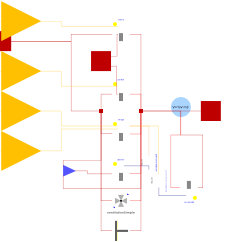
Information
Linearised and time-invariant model of a single zone considering equivalent building components
Hypothesis and equations
This model allows the representation of Individual House / Collective Housing / Tertiary Building in single zone. The modelling is simplified to consider only an equivalent external wall and an equivalent glazing surface both being independant of the orientation.
The level of thermal losses represented by Ubat is a parameter of the model. This model leads to a linear time-invariant model that can be reduced.
Geometry
Model of a parallelepiped 0D-1D square section single-zone. The building height depends on the number of levels (NbNiveau), on total air volume (Vair) and on the living area (SH). Glazing are defined by a total surface.
Building typology
Constructive system (materials and layers thicknesses) are considered in detail through wall definition caracParoiExt, caracPlancher...
Inertia is adjustable by choosing the constructive mode.
Physics
The building envelope is decomposed into 3 equivalent models for external walls, roof and floor. The external wall and roof models are subject to short-wave and long-wave radiations (SWR and LWR).
Long-wave radiations on the external walls and roof are outsourced and should be computed through the Ts connector.
The calculation of incident and transmitted irradiations is outsourced of this model and is performed by a SolarBC model. This calculation is detailed and considers the influence of the walls and glazing orientation. Therefore the non-linear incidence of the angle of incidence for short-wave radiation, is outsourced. The transmitted irradiation through the glazing is absorbed on floor(s) surface.
The coefficient B defined a boundary condition in term of temperature on the outer face of the lowest floor.
Bibliography
Refer to walls and glazings modelling assumptions.
Eui-Jong Kim, Gilles Plessis, Jean-Luc Hubert, Jean-Jacques Roux, 2014.Urban energy simulation: Simplification and reduction of building envelope models. Energy and Buildings 84 p193-202.
Instructions for use
The irradiation connectors should be connected to SolarBC models. The outdoor temperature port must be connected to a weather data reader Meteofile.
Known limits / Use precautions
none
Validations
Validated model - Gilles Plessis, Hassan Bouia 07/2015
--------------------------------------------------------------
Licensed by EDF under a 3-clause BSD-license
Copyright © EDF 2009 - 2023
BuildSysPro version 3.6.0
Author : Gilles PLESSIS, Hassan BOUIA, EDF (2013)
--------------------------------------------------------------
Parameters
| Type | Name | Default | Description |
|---|---|---|---|
| Global parameters | |||
| Integer | NbNiveaux | Number of floors, minimum = 1 | |
| Modelica.Units.SI.Volume | Vair | 240 | Air volume |
| Modelica.Units.SI.Area | SH | 100 | Living surface area |
| Real | renouv | Ventilation and/or infiltration flow [vol/h] | |
| Modelica.Units.SI.ThermalConductance | Psi_L | Thermal bridge coefficient | |
| Glazing | |||
| Modelica.Units.SI.Area | SurfaceVitree | Total glazed surface | |
| Modelica.Units.SI.CoefficientOfHeatTransfer | U | 1 | Glazing deperditive coefficient |
| Real | AbsVitrage | 0.1 | Absorptance |
| Modelica.Units.SI.CoefficientOfHeatTransfer | hs_ext_Vitrage | 16.7 | Convective heat transfer coefficient on the outer face |
| Modelica.Units.SI.CoefficientOfHeatTransfer | hs_int_Vitrage | 9.1 | Convective heat transfer coefficient on the inner face |
| Walls | |||
| BuildSysPro.Utilities.Records.GenericWall | caracParoiExt | External walls definition | |
| Modelica.Units.SI.Area | SParoiExt | Deperditive surface area of vertical walls | |
| Modelica.Units.SI.CoefficientOfHeatTransfer | hs_ext_ParoiExt | 25 | Convective heat transfer coefficient on the outer face for the vertical walls |
| Modelica.Units.SI.CoefficientOfHeatTransfer | hs_int_ParoiExt | 7.7 | Convective heat transfer coefficient on the inner face for the vertical walls |
| BuildSysPro.Utilities.Records.GenericWall | caracPlancher | Floor definition | |
| Modelica.Units.SI.CoefficientOfHeatTransfer | hs_inf_Plancher | 25 | Convective heat transfer coefficient on the lower face for the floors |
| Modelica.Units.SI.CoefficientOfHeatTransfer | hs_sup_Plancher | 7.7 | Convective heat transfer coefficient on the upper face for the floors |
| BuildSysPro.Utilities.Records.GenericWall | caracToiture | Roof definition | |
| Modelica.Units.SI.Area | SToiture | Deperditive surface area of the roofs | |
| Modelica.Units.SI.CoefficientOfHeatTransfer | hs_ext_Toiture | 25 | Convective heat transfer coefficient on the outer face for the roofs |
| Modelica.Units.SI.CoefficientOfHeatTransfer | hs_int_Toiture | 7.7 | Convective heat transfer coefficient on the inner face for the roofs |
| Real | b | 1 | Weighting coefficient for non-heated zones |
| Real | alpha_ext | 0.8 | Absorptance of outer walls SWR |
| Real | epsParois | 0.9 | Outer walls emissivity in LWR |
| Initialisation | |||
| Modelica.Units.SI.Temperature | Tinit | 293.15 | Initialisation temperature |
Connectors
| Type | Name | Default | Description |
|---|---|---|---|
| BuildSysPro.BaseClasses.HeatTransfer.Interfaces.HeatPort_a | T_ext | Air temperature | |
| BuildSysPro.BaseClasses.HeatTransfer.Interfaces.HeatPort_a | T_int | Indoor air heat port | |
| BuildSysPro.BoundaryConditions.Solar.Interfaces.SolarFluxInput | FluxIncGlazing | Surface incident solar flux on glazings | |
| BuildSysPro.BoundaryConditions.Solar.Interfaces.SolarFluxInput | FluxIncWall | Surface incident solar flux on external walls | |
| BuildSysPro.BoundaryConditions.Solar.Interfaces.SolarFluxInput | FluxTrGlazing | Transmitted solar flux through glazings (must take into account the influence of incidence) | |
| BuildSysPro.BoundaryConditions.Solar.Interfaces.SolarFluxInput | FluxIncRoof | Surface incident solar flux on external roofs | |
| BuildSysPro.BaseClasses.HeatTransfer.Interfaces.HeatPort_a[2] | Ts_ext | Surface temperature for LW radiation (roof and external walls) |
Revisions
Gilles Plessis 07/2015 : Modèle dérivé de MonozoneSimplifie de BuildSysPro 2015.04 pour les besoin du projet ANR MERUBBI.
Ajout d'un composant pour la toiture et pont thermique.
Les échanges GLO linéaire sont supprimés pour être externalisé via le port Ts grâce à un calcul de facteur de forme.
Benoît Charrier 02/2017 : Deleting useless solar transmission coefficient Tr because of transmitted solar radiation in input.