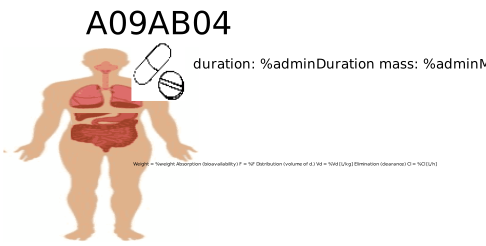
modelA09AB04
Extends from Pharmacokinetic.Models.PK_1C_enteral.
Information
| name: | CitricAcid | |
| ATC code: | A09AB04 | route: | oral |
| compartments: | 1 | |
| dosage: | 1000 | mg |
| volume of distribution: | 0.2 | L |
| clearance: | 0.15 | L/min |
| other parameters in model implementation | ||
Citric acid is a weak organic acid commonly found in citrus fruits. In medicine, it is used as an ingredient in digestive and effervescent preparations, often to promote gastric acidity and assist in the breakdown of kidney stones. Citric acid is also utilized as an excipient and pH adjuster in pharmaceutical formulations. As a single agent, it is rarely used therapeutically, and there is no specific systemic pharmacotherapy approved today exclusively for citric acid.
Pharmacokinetics
No published pharmacokinetic studies with typical model parameters for citric acid as a single drug in humans were found. The following is an estimate of pharmacokinetic parameters for oral administration based on general knowledge of weak acids and literature about citric acid metabolism and use.
References
Hoy, SM, et al., & Wagstaff, AJ (2009). Sodium picosulfate/magnesium citrate: a review of its use as a colorectal cleanser. Drugs 69(1) 123–136. DOI:10.2165/00003495-200969010-00009 PUBMED:https://pubmed.ncbi.nlm.nih.gov/19192941
Pelfrêne, A, et al., & Le Bot, B (2020). Evaluation of single-extraction methods to estimate the oral bioaccessibility of metal(loid)s in soils. The Science of the total environment 727 138553–None. DOI:10.1016/j.scitotenv.2020.138553 PUBMED:https://pubmed.ncbi.nlm.nih.gov/32334219
Argiratos, V, & Samman, S (1994). The effect of calcium carbonate and calcium citrate on the absorption of zinc in healthy female subjects. European journal of clinical nutrition 48(3) 198–204. PUBMED:https://pubmed.ncbi.nlm.nih.gov/8194505
Parameters
| Type | Name | Default | Description |
|---|---|---|---|
| Modelica.Units.SI.Mass | weight (from PK_1C) | 75 | patient weight (kg) |
| Modelica.Units.SI.SpecificVolume | VdPerKg (from PK_1C) | 0.9 | Volume of distribution (L/kg) |
| Modelica.Units.SI.MassFraction | F (from PK_1C) | 0.8 | bioavailiability (0-1) |
| Pharmacolibrary.Types.Clearance | Cl (from PK_1C) | 20 | clearance |
| Modelica.Units.SI.Time | adminTime (from PK_1C) | 60 | first administration time (s) |
| Modelica.Units.SI.Time | adminDuration (from PK_1C) | 600 | administration duration (s) |
| Modelica.Units.SI.Time | adminPeriod (from PK_1C) | 8*60*60 | period of administration (default 8 hours)(s) |
| Pharmacolibrary.Types.Mass | adminMass (from PK_1C) | 1000 | administration mass (mg) |
| Integer | adminCount (from PK_1C) | 8 | number of dose administered (1) |
| Pharmacolibrary.Types.Volume | Vd (from PK_1C) | VdPerKg*weight | Volume of distribution (m3) |
| Pharmacolibrary.Types.MassConcentration | Cmin (from PK_1C) | 0.004 | minimal therapeutic range |
| Pharmacolibrary.Types.MassConcentration | Cmax (from PK_1C) | 0.008 | minimal therapeutic range |
| Pharmacolibrary.Types.MassConcentration | Ctox_peak (from PK_1C) | 0.012 | toxicity peak level |
| Pharmacolibrary.Types.MassConcentration | Ctox_trough (from PK_1C) | 0.006 | toxicity trough level |
| Pharmacolibrary.Types.TransferRate | ka (from PK_1C_enteral) | 0.016666666666666666 | first order absorption rate |
| Modelica.Units.SI.Time | Tlag (from PK_1C_enteral) | 600 | delay between oral administration and absorption (default 10min) |
Connectors
| Type | Name | Default | Description |
|---|---|---|---|
| Types.ConcentrationOutput | C_central (from PK_1C) | ||
| Interfaces.ConcentrationPort_b | centralCPort (from PK_1C) |
Components
| Type | Name | Default | Description |
|---|---|---|---|
| Pharmacokinetic.NoPerfusedTissueCompartment | central (from PK_1C) | ||
| Pharmacokinetic.ClearanceDrivenElimination | elim (from PK_1C) | ||
| Sources.PeriodicDose | periodicDose (from PK_1C) | ||
| Modelica.Units.SI.Time | t1_2 (from PK_1C) | elimination half-life |
Revisions
- 06/2025 Tomas Kulhanek, generated model from data extracted from PUBMED, DrugBank and LLM(GPT4.1)