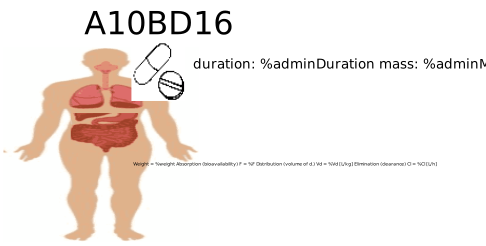
modelA10BD16
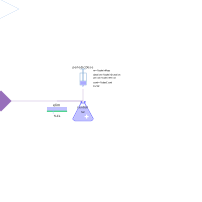
Extends from Pharmacokinetic.Models.PK_1C_enteral.
Information
| name: | MetforminAndCanagliflozin | |
| ATC code: | A10BD16 | route: | oral |
| compartments: | 1 | |
| dosage: | 1300 | mg |
| volume of distribution: | 150 | L |
| clearance: | 40 | L/h |
| other parameters in model implementation | ||
Metformin and canagliflozin is a fixed-dose combination medication used for the treatment of type 2 diabetes mellitus in adults. Metformin is a biguanide antihyperglycemic agent primarily used to improve glycemic control by decreasing hepatic glucose production and increasing insulin sensitivity, while canagliflozin is a sodium-glucose co-transporter 2 (SGLT2) inhibitor that reduces glucose reabsorption in the kidney, resulting in increased urinary glucose excretion. This combination is currently approved and marketed for medical use.
Pharmacokinetics
Pharmacokinetic parameters estimated for average healthy adults, as direct pharmacokinetic parameterization of the fixed-dose combination is not available in publication. Parameters for each component are approximated from studies of individual drugs. Estimated for oral administration of metformin (1000 mg) and canagliflozin (300 mg).
References
Wattamwar, T, et al., & Pandita, N (2020). Development of LC-MS/MS method for simultaneous determination of Canagliflozin and Metformin in human plasma and its pharmacokinetic application in Indian population under fast and fed conditions. Journal of chromatography. B, Analytical technologies in the biomedical and life sciences 1154 122281–None. DOI:10.1016/j.jchromb.2020.122281 PUBMED:https://pubmed.ncbi.nlm.nih.gov/32763846
Scheen, AJ (2015). Pharmacodynamics, efficacy and safety of sodium-glucose co-transporter type 2 (SGLT2) inhibitors for the treatment of type 2 diabetes mellitus. Drugs 75(1) 33–59. DOI:10.1007/s40265-014-0337-y PUBMED:https://pubmed.ncbi.nlm.nih.gov/25488697
Parameters
| Type | Name | Default | Description |
|---|---|---|---|
| Modelica.Units.SI.Mass | weight (from PK_1C) | 75 | patient weight (kg) |
| Modelica.Units.SI.SpecificVolume | VdPerKg (from PK_1C) | 0.9 | Volume of distribution (L/kg) |
| Modelica.Units.SI.MassFraction | F (from PK_1C) | 0.8 | bioavailiability (0-1) |
| Pharmacolibrary.Types.Clearance | Cl (from PK_1C) | 20 | clearance |
| Modelica.Units.SI.Time | adminTime (from PK_1C) | 60 | first administration time (s) |
| Modelica.Units.SI.Time | adminDuration (from PK_1C) | 600 | administration duration (s) |
| Modelica.Units.SI.Time | adminPeriod (from PK_1C) | 8*60*60 | period of administration (default 8 hours)(s) |
| Pharmacolibrary.Types.Mass | adminMass (from PK_1C) | 1000 | administration mass (mg) |
| Integer | adminCount (from PK_1C) | 8 | number of dose administered (1) |
| Pharmacolibrary.Types.Volume | Vd (from PK_1C) | VdPerKg*weight | Volume of distribution (m3) |
| Pharmacolibrary.Types.MassConcentration | Cmin (from PK_1C) | 0.004 | minimal therapeutic range |
| Pharmacolibrary.Types.MassConcentration | Cmax (from PK_1C) | 0.008 | minimal therapeutic range |
| Pharmacolibrary.Types.MassConcentration | Ctox_peak (from PK_1C) | 0.012 | toxicity peak level |
| Pharmacolibrary.Types.MassConcentration | Ctox_trough (from PK_1C) | 0.006 | toxicity trough level |
| Pharmacolibrary.Types.TransferRate | ka (from PK_1C_enteral) | 0.016666666666666666 | first order absorption rate |
| Modelica.Units.SI.Time | Tlag (from PK_1C_enteral) | 600 | delay between oral administration and absorption (default 10min) |
Connectors
| Type | Name | Default | Description |
|---|---|---|---|
| Types.ConcentrationOutput | C_central (from PK_1C) | ||
| Interfaces.ConcentrationPort_b | centralCPort (from PK_1C) |
Components
| Type | Name | Default | Description |
|---|---|---|---|
| Pharmacokinetic.NoPerfusedTissueCompartment | central (from PK_1C) | ||
| Pharmacokinetic.ClearanceDrivenElimination | elim (from PK_1C) | ||
| Sources.PeriodicDose | periodicDose (from PK_1C) | ||
| Modelica.Units.SI.Time | t1_2 (from PK_1C) | elimination half-life |
Revisions
- 06/2025 Tomas Kulhanek, generated model from data extracted from PUBMED, DrugBank and LLM(GPT4.1)