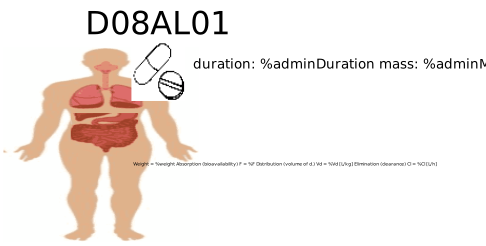
modelD08AL01
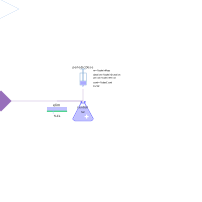
Extends from Pharmacokinetic.Models.PK_1C.
Information
| name: | SilverNitrate | |
| ATC code: | D08AL01 | route: |
| compartments: | 1 | |
| dosage: | 1 | mg |
| volume of distribution: | 1 | L |
| clearance: | 0 | |
| other parameters in model implementation | ||
Silver nitrate is an inorganic compound formerly used as a topical antiseptic and for cauterization of wounds. Historically, it has been used to prevent ophthalmia neonatorum (eye infection in newborns). Due to toxicity and the emergence of more specific agents, it is rarely used today and has limited applications in clinical medicine.
Pharmacokinetics
No pharmacokinetic data regarding absorption, distribution, metabolism, or excretion of silver nitrate in humans is available in the published literature. Due to its highly reactive ionic nature and local mechanism of action, systemic pharmacokinetics are generally not relevant. Any attempt at compartmental modeling or parameter estimation is speculative.
References
Nguyen, RC, et al., & LeBlanc, A (1999). Argyremia in septal cauterization with silver nitrate. The Journal of otolaryngology 28(4) 211–216. PUBMED:https://pubmed.ncbi.nlm.nih.gov/10461258
Kumari, N, et al., & Jagadevan, S (2019). Arsenite biotransformation by Rhodococcus sp.: Characterization, optimization using response surface methodology and mechanistic studies. The Science of the total environment 687 577–589. DOI:10.1016/j.scitotenv.2019.06.077 PUBMED:https://pubmed.ncbi.nlm.nih.gov/31216511
Fernández, A, et al., & Lloret, E (2010). Cellulose-silver nanoparticle hybrid materials to control spoilage-related microflora in absorbent pads located in trays of fresh-cut melon. International journal of food microbiology 142(1-2) 222–228. DOI:10.1016/j.ijfoodmicro.2010.07.001 PUBMED:https://pubmed.ncbi.nlm.nih.gov/20656367
Parameters
| Type | Name | Default | Description |
|---|---|---|---|
| Modelica.Units.SI.Mass | weight (from PK_1C) | 75 | patient weight (kg) |
| Modelica.Units.SI.SpecificVolume | VdPerKg (from PK_1C) | 0.9 | Volume of distribution (L/kg) |
| Modelica.Units.SI.MassFraction | F (from PK_1C) | 0.8 | bioavailiability (0-1) |
| Pharmacolibrary.Types.Clearance | Cl (from PK_1C) | 20 | clearance |
| Modelica.Units.SI.Time | adminTime (from PK_1C) | 60 | first administration time (s) |
| Modelica.Units.SI.Time | adminDuration (from PK_1C) | 600 | administration duration (s) |
| Modelica.Units.SI.Time | adminPeriod (from PK_1C) | 8*60*60 | period of administration (default 8 hours)(s) |
| Pharmacolibrary.Types.Mass | adminMass (from PK_1C) | 1000 | administration mass (mg) |
| Integer | adminCount (from PK_1C) | 8 | number of dose administered (1) |
| Pharmacolibrary.Types.Volume | Vd (from PK_1C) | VdPerKg*weight | Volume of distribution (m3) |
| Pharmacolibrary.Types.MassConcentration | Cmin (from PK_1C) | 0.004 | minimal therapeutic range |
| Pharmacolibrary.Types.MassConcentration | Cmax (from PK_1C) | 0.008 | minimal therapeutic range |
| Pharmacolibrary.Types.MassConcentration | Ctox_peak (from PK_1C) | 0.012 | toxicity peak level |
| Pharmacolibrary.Types.MassConcentration | Ctox_trough (from PK_1C) | 0.006 | toxicity trough level |
Connectors
| Type | Name | Default | Description |
|---|---|---|---|
| Types.ConcentrationOutput | C_central (from PK_1C) | ||
| Interfaces.ConcentrationPort_b | centralCPort (from PK_1C) |
Components
| Type | Name | Default | Description |
|---|---|---|---|
| Pharmacokinetic.NoPerfusedTissueCompartment | central (from PK_1C) | ||
| Pharmacokinetic.ClearanceDrivenElimination | elim (from PK_1C) | ||
| Sources.PeriodicDose | periodicDose (from PK_1C) | ||
| Modelica.Units.SI.Time | t1_2 (from PK_1C) | elimination half-life |
Revisions
- 06/2025 Tomas Kulhanek, generated model from data extracted from PUBMED, DrugBank and LLM(GPT4.1)