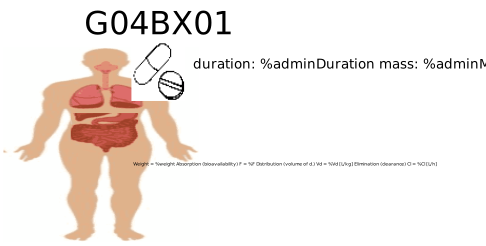
modelG04BX01
Extends from Pharmacokinetic.Models.PK_1C_enteral.
Information
| name: | MagnesiumHydroxide | |
| ATC code: | G04BX01 | route: | oral |
| compartments: | 1 | |
| dosage: | 1200 | mg |
| volume of distribution: | 0.3 | L |
| clearance: | 6 | L/h |
| other parameters in model implementation | ||
Magnesium hydroxide is an inorganic compound used as an antacid to relieve indigestion, heartburn, or dyspepsia, and as a laxative for short-term treatment of constipation. It is available over the counter and is commonly known as 'milk of magnesia.' Magnesium hydroxide is widely used and considered safe for short-term use. The drug is approved and widely used today.
Pharmacokinetics
No specific pharmacokinetic models or parameters for magnesium hydroxide in humans are described in published literature. Magnesium from magnesium hydroxide is absorbed to a very limited extent (<15%) in the gastrointestinal tract, with the majority being excreted unchanged in feces.
References
Scott, G, et al., & Rordorf, C (2004). Lack of effect of omeprazole or of an aluminium hydroxide/magnesium hydroxide antacid on the pharmacokinetics of lumiracoxib. Clinical pharmacokinetics 43(5) 341–348. DOI:10.2165/00003088-200443050-00006 PUBMED:https://pubmed.ncbi.nlm.nih.gov/15080766
Smith, GW, & Correa, MT (2004). The effects of oral magnesium hydroxide administration on rumen fluid in cattle. Journal of veterinary internal medicine 18(1) 109–112. DOI:10.1892/0891-6640(2004)18<109:teoomh>2.0.co;2 PUBMED:https://pubmed.ncbi.nlm.nih.gov/14765740
Zhang, YF, et al., & Zhong, DF (2014). Effects of an Al(3+)- and Mg(2+)-containing antacid, ferrous sulfate, and calcium carbonate on the absorption of nemonoxacin (TG-873870) in healthy Chinese volunteers. Acta pharmacologica Sinica 35(12) 1586–1592. DOI:10.1038/aps.2014.95 PUBMED:https://pubmed.ncbi.nlm.nih.gov/25327812
Parameters
| Type | Name | Default | Description |
|---|---|---|---|
| Modelica.Units.SI.Mass | weight (from PK_1C) | 75 | patient weight (kg) |
| Modelica.Units.SI.SpecificVolume | VdPerKg (from PK_1C) | 0.9 | Volume of distribution (L/kg) |
| Modelica.Units.SI.MassFraction | F (from PK_1C) | 0.8 | bioavailiability (0-1) |
| Pharmacolibrary.Types.Clearance | Cl (from PK_1C) | 20 | clearance |
| Modelica.Units.SI.Time | adminTime (from PK_1C) | 60 | first administration time (s) |
| Modelica.Units.SI.Time | adminDuration (from PK_1C) | 600 | administration duration (s) |
| Modelica.Units.SI.Time | adminPeriod (from PK_1C) | 8*60*60 | period of administration (default 8 hours)(s) |
| Pharmacolibrary.Types.Mass | adminMass (from PK_1C) | 1000 | administration mass (mg) |
| Integer | adminCount (from PK_1C) | 8 | number of dose administered (1) |
| Pharmacolibrary.Types.Volume | Vd (from PK_1C) | VdPerKg*weight | Volume of distribution (m3) |
| Pharmacolibrary.Types.MassConcentration | Cmin (from PK_1C) | 0.004 | minimal therapeutic range |
| Pharmacolibrary.Types.MassConcentration | Cmax (from PK_1C) | 0.008 | minimal therapeutic range |
| Pharmacolibrary.Types.MassConcentration | Ctox_peak (from PK_1C) | 0.012 | toxicity peak level |
| Pharmacolibrary.Types.MassConcentration | Ctox_trough (from PK_1C) | 0.006 | toxicity trough level |
| Pharmacolibrary.Types.TransferRate | ka (from PK_1C_enteral) | 0.016666666666666666 | first order absorption rate |
| Modelica.Units.SI.Time | Tlag (from PK_1C_enteral) | 600 | delay between oral administration and absorption (default 10min) |
Connectors
| Type | Name | Default | Description |
|---|---|---|---|
| Types.ConcentrationOutput | C_central (from PK_1C) | ||
| Interfaces.ConcentrationPort_b | centralCPort (from PK_1C) |
Components
| Type | Name | Default | Description |
|---|---|---|---|
| Pharmacokinetic.NoPerfusedTissueCompartment | central (from PK_1C) | ||
| Pharmacokinetic.ClearanceDrivenElimination | elim (from PK_1C) | ||
| Sources.PeriodicDose | periodicDose (from PK_1C) | ||
| Modelica.Units.SI.Time | t1_2 (from PK_1C) | elimination half-life |
Revisions
- 06/2025 Tomas Kulhanek, generated model from data extracted from PUBMED, DrugBank and LLM(GPT4.1)