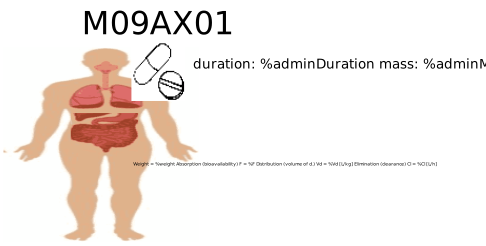
modelM09AX01
Extends from Pharmacokinetic.Models.PK_1C.
Information
| name: | HyaluronicAcid | |
| ATC code: | M09AX01 | route: | intraarticular |
| compartments: | 1 | |
| dosage: | 20 | mg |
| volume of distribution: | 0.07 | L |
| clearance: | 3.6 | mL/min/kg |
| other parameters in model implementation | ||
Hyaluronic acid is a naturally occurring glycosaminoglycan used in medicine for joint disorders (such as osteoarthritis), for intra-articular injections, ophthalmology (such as in cataract surgery), dermatology (as a dermal filler), and wound healing. Approved for use in many countries, its main approved parenteral uses are in osteoarthritis and ophthalmology.
Pharmacokinetics
No population pharmacokinetic models in humans following parenteral or oral administration are available in published literature. Hyaluronic acid is mostly used intra-articularly or topically; systemic PK after intra-articular administration in humans is not well described. Estimates are based on its known biological half-life, synovial fluid turnover, and animal studies.
References
Miranda, DG, et al., & Gritsch, K (2024). Ketoprofen Associated with Hyaluronic Acid Hydrogel for Temporomandibular Disorder Treatment: An In Vitro Study. Gels (Basel, Switzerland) 10(12) –. DOI:10.3390/gels10120811 PUBMED:https://pubmed.ncbi.nlm.nih.gov/39727570
Magri, G, et al., & Fotaki, N (2019). Biorelevant release testing of biodegradable microspheres intended for intra-articular administration. European journal of pharmaceutics and biopharmaceutics : official journal of Arbeitsgemeinschaft fur Pharmazeutische Verfahrenstechnik e.V 139 115–122. DOI:10.1016/j.ejpb.2019.03.019 PUBMED:https://pubmed.ncbi.nlm.nih.gov/30905777
Wang, X, et al., & Chen, Y (2025). Dissolving microneedles: A transdermal drug delivery system for the treatment of rheumatoid arthritis. International journal of pharmaceutics 671 125206–None. DOI:10.1016/j.ijpharm.2025.125206 PUBMED:https://pubmed.ncbi.nlm.nih.gov/39799999
Parameters
| Type | Name | Default | Description |
|---|---|---|---|
| Modelica.Units.SI.Mass | weight (from PK_1C) | 75 | patient weight (kg) |
| Modelica.Units.SI.SpecificVolume | VdPerKg (from PK_1C) | 0.9 | Volume of distribution (L/kg) |
| Modelica.Units.SI.MassFraction | F (from PK_1C) | 0.8 | bioavailiability (0-1) |
| Pharmacolibrary.Types.Clearance | Cl (from PK_1C) | 20 | clearance |
| Modelica.Units.SI.Time | adminTime (from PK_1C) | 60 | first administration time (s) |
| Modelica.Units.SI.Time | adminDuration (from PK_1C) | 600 | administration duration (s) |
| Modelica.Units.SI.Time | adminPeriod (from PK_1C) | 8*60*60 | period of administration (default 8 hours)(s) |
| Pharmacolibrary.Types.Mass | adminMass (from PK_1C) | 1000 | administration mass (mg) |
| Integer | adminCount (from PK_1C) | 8 | number of dose administered (1) |
| Pharmacolibrary.Types.Volume | Vd (from PK_1C) | VdPerKg*weight | Volume of distribution (m3) |
| Pharmacolibrary.Types.MassConcentration | Cmin (from PK_1C) | 0.004 | minimal therapeutic range |
| Pharmacolibrary.Types.MassConcentration | Cmax (from PK_1C) | 0.008 | minimal therapeutic range |
| Pharmacolibrary.Types.MassConcentration | Ctox_peak (from PK_1C) | 0.012 | toxicity peak level |
| Pharmacolibrary.Types.MassConcentration | Ctox_trough (from PK_1C) | 0.006 | toxicity trough level |
Connectors
| Type | Name | Default | Description |
|---|---|---|---|
| Types.ConcentrationOutput | C_central (from PK_1C) | ||
| Interfaces.ConcentrationPort_b | centralCPort (from PK_1C) |
Components
| Type | Name | Default | Description |
|---|---|---|---|
| Pharmacokinetic.NoPerfusedTissueCompartment | central (from PK_1C) | ||
| Pharmacokinetic.ClearanceDrivenElimination | elim (from PK_1C) | ||
| Sources.PeriodicDose | periodicDose (from PK_1C) | ||
| Modelica.Units.SI.Time | t1_2 (from PK_1C) | elimination half-life |
Revisions
- 06/2025 Tomas Kulhanek, generated model from data extracted from PUBMED, DrugBank and LLM(GPT4.1)