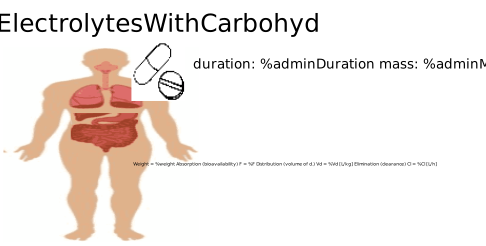
modelElectrolytesWithCarbohyd
Extends from Pharmacolibrary.Drugs.ATC.B.B05BB02.
Information
| name: | ElectrolytesWithCarbohydrates | |
| ATC code: | B05BB02 | route: | oral |
| compartments: | 1 | |
| dosage: | 200 | mg |
| volume of distribution: | 14 | L |
| clearance: | 90 | ml/min |
| other parameters in model implementation | ||
Electrolytes with carbohydrates are used as oral or intravenous rehydration solutions for the treatment and prevention of dehydration due to diarrhea, vomiting, or other conditions causing fluid loss. They commonly contain sodium, potassium, chloride, bicarbonate (or citrate), and glucose or other simple carbohydrates to facilitate absorption via the sodium-glucose transporter. These products are widely used and accepted in clinical practice and are recommended by the WHO for oral rehydration therapy.
Pharmacokinetics
No dedicated pharmacokinetic modeling studies are available for the composite product 'electrolytes with carbohydrates' as a drug entity in healthy volunteers or specific patient groups. Absorption and disposition of oral rehydration solutions are governed by physiological processes of intestinal uptake and renal excretion.
References
Holtug, K, et al., & Skadhauge, E (1996). Experimental studies of intestinal ion and water transport. Scandinavian journal of gastroenterology. Supplement 216 95–110. DOI:10.3109/00365529609094565 PUBMED:https://pubmed.ncbi.nlm.nih.gov/8726283
Sze, DM, & Chan, GC (2009). Supplements for immune enhancement in hematologic malignancies. Hematology. American Society of Hematology. Education Program None 313–319. DOI:10.1182/asheducation-2009.1.313 PUBMED:https://pubmed.ncbi.nlm.nih.gov/20008216
Feng, Y, et al., & Wu, H (2024). Microalgae polyphosphate nanoparticles deliver bioavailable calcium against phytate antagonism: Ex vivo and in vivo studies. Food research international (Ottawa, Ont.) 186 114321–None. DOI:10.1016/j.foodres.2024.114321 PUBMED:https://pubmed.ncbi.nlm.nih.gov/38729691
Parameters
| Type | Name | Default | Description |
|---|---|---|---|
| Modelica.Units.SI.Mass | weight (from PK_1C) | 75 | patient weight (kg) |
| Modelica.Units.SI.SpecificVolume | VdPerKg (from PK_1C) | 0.9 | Volume of distribution (L/kg) |
| Modelica.Units.SI.MassFraction | F (from PK_1C) | 0.8 | bioavailiability (0-1) |
| Pharmacolibrary.Types.Clearance | Cl (from PK_1C) | 20 | clearance |
| Modelica.Units.SI.Time | adminTime (from PK_1C) | 60 | first administration time (s) |
| Modelica.Units.SI.Time | adminDuration (from PK_1C) | 600 | administration duration (s) |
| Modelica.Units.SI.Time | adminPeriod (from PK_1C) | 8*60*60 | period of administration (default 8 hours)(s) |
| Pharmacolibrary.Types.Mass | adminMass (from PK_1C) | 1000 | administration mass (mg) |
| Integer | adminCount (from PK_1C) | 8 | number of dose administered (1) |
| Pharmacolibrary.Types.Volume | Vd (from PK_1C) | VdPerKg*weight | Volume of distribution (m3) |
| Pharmacolibrary.Types.MassConcentration | Cmin (from PK_1C) | 0.004 | minimal therapeutic range |
| Pharmacolibrary.Types.MassConcentration | Cmax (from PK_1C) | 0.008 | minimal therapeutic range |
| Pharmacolibrary.Types.MassConcentration | Ctox_peak (from PK_1C) | 0.012 | toxicity peak level |
| Pharmacolibrary.Types.MassConcentration | Ctox_trough (from PK_1C) | 0.006 | toxicity trough level |
| Pharmacolibrary.Types.TransferRate | ka (from PK_1C_enteral) | 0.016666666666666666 | first order absorption rate |
| Modelica.Units.SI.Time | Tlag (from PK_1C_enteral) | 600 | delay between oral administration and absorption (default 10min) |
Connectors
| Type | Name | Default | Description |
|---|---|---|---|
| Types.ConcentrationOutput | C_central (from PK_1C) | ||
| Interfaces.ConcentrationPort_b | centralCPort (from PK_1C) |
Components
| Type | Name | Default | Description |
|---|---|---|---|
| Pharmacokinetic.NoPerfusedTissueCompartment | central (from PK_1C) | ||
| Pharmacokinetic.ClearanceDrivenElimination | elim (from PK_1C) | ||
| Sources.PeriodicDose | periodicDose (from PK_1C) | ||
| Modelica.Units.SI.Time | t1_2 (from PK_1C) | elimination half-life |
Revisions
- 06/2025 Tomas Kulhanek, generated model from data extracted from PUBMED, DrugBank and LLM(GPT4.1)