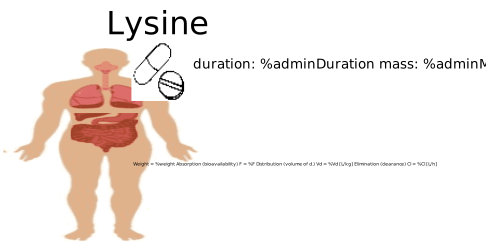
modelLysine
Extends from Pharmacolibrary.Drugs.ATC.B.B05XB03.
Information
| name: | Lysine | |
| ATC code: | B05XB03 | route: | intravenous |
| compartments: | 1 | |
| dosage: | 5000 | mg |
| volume of distribution: | 25 | L |
| clearance: | 150 | ml/min |
| other parameters in model implementation | ||
Lysine is an essential amino acid used primarily as a nutritional supplement and for the treatment of lysine deficiency states. Intravenously, lysine has been explored as a component of amino acid solutions for parenteral nutrition and as a renal radioprotector during peptide receptor radionuclide therapy (PRRT). Lysine itself is not typically used as a standalone drug but is included within certain medical or metabolic contexts. Lysine is approved for use as a nutritional supplement, but intravenous formulations for therapeutic or diagnostic use (e.g., renal protection) are typically off-label or investigational.
Pharmacokinetics
Estimated pharmacokinetic parameters for intravenous lysine in healthy adults based on available literature for amino acid infusion. Direct published PK models specifically for lysine with ATC B05XB03 are not available; these are general estimates extrapolated from parenteral amino acid/supplement studies.
References
Zhao, L, et al., & Bi, K (2012). Bioequivalence and population pharmacokinetic modeling of two forms of antibiotic, cefuroxime lysine and cefuroxime sodium, after intravenous infusion in beagle dogs. Journal of biomedicine & biotechnology 2012 507294–None. DOI:10.1155/2012/507294 PUBMED:https://pubmed.ncbi.nlm.nih.gov/22911056
Grimaldi, R, et al., & Gaita, F (2014). Laboratory aspirin resistance reversibility in diabetic patients: a pilot study using different pharmaceutical formulations. Cardiovascular drugs and therapy 28(4) 323–329. DOI:10.1007/s10557-014-6536-7 PUBMED:https://pubmed.ncbi.nlm.nih.gov/24984883
Peer, CJ, et al., & Figg, WD (2016). UGT1A1 genotype-dependent dose adjustment of belinostat in patients with advanced cancers using population pharmacokinetic modeling and simulation. Journal of clinical pharmacology 56(4) 450–460. DOI:10.1002/jcph.627 PUBMED:https://pubmed.ncbi.nlm.nih.gov/26637161
Parameters
| Type | Name | Default | Description |
|---|---|---|---|
| Modelica.Units.SI.Mass | weight (from PK_1C) | 75 | patient weight (kg) |
| Modelica.Units.SI.SpecificVolume | VdPerKg (from PK_1C) | 0.9 | Volume of distribution (L/kg) |
| Modelica.Units.SI.MassFraction | F (from PK_1C) | 0.8 | bioavailiability (0-1) |
| Pharmacolibrary.Types.Clearance | Cl (from PK_1C) | 20 | clearance |
| Modelica.Units.SI.Time | adminTime (from PK_1C) | 60 | first administration time (s) |
| Modelica.Units.SI.Time | adminDuration (from PK_1C) | 600 | administration duration (s) |
| Modelica.Units.SI.Time | adminPeriod (from PK_1C) | 8*60*60 | period of administration (default 8 hours)(s) |
| Pharmacolibrary.Types.Mass | adminMass (from PK_1C) | 1000 | administration mass (mg) |
| Integer | adminCount (from PK_1C) | 8 | number of dose administered (1) |
| Pharmacolibrary.Types.Volume | Vd (from PK_1C) | VdPerKg*weight | Volume of distribution (m3) |
| Pharmacolibrary.Types.MassConcentration | Cmin (from PK_1C) | 0.004 | minimal therapeutic range |
| Pharmacolibrary.Types.MassConcentration | Cmax (from PK_1C) | 0.008 | minimal therapeutic range |
| Pharmacolibrary.Types.MassConcentration | Ctox_peak (from PK_1C) | 0.012 | toxicity peak level |
| Pharmacolibrary.Types.MassConcentration | Ctox_trough (from PK_1C) | 0.006 | toxicity trough level |
Connectors
| Type | Name | Default | Description |
|---|---|---|---|
| Types.ConcentrationOutput | C_central (from PK_1C) | ||
| Interfaces.ConcentrationPort_b | centralCPort (from PK_1C) |
Components
| Type | Name | Default | Description |
|---|---|---|---|
| Pharmacokinetic.NoPerfusedTissueCompartment | central (from PK_1C) | ||
| Pharmacokinetic.ClearanceDrivenElimination | elim (from PK_1C) | ||
| Sources.PeriodicDose | periodicDose (from PK_1C) | ||
| Modelica.Units.SI.Time | t1_2 (from PK_1C) | elimination half-life |
Revisions
- 06/2025 Tomas Kulhanek, generated model from data extracted from PUBMED, DrugBank and LLM(GPT4.1)