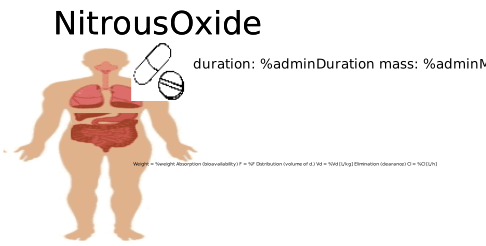
modelNitrousOxide
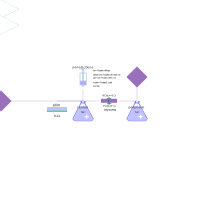
Extends from Pharmacolibrary.Drugs.ATC.N.N01AX13.
Information
| name: | NitrousOxide | |
| ATC code: | N01AX13 | route: | inhalation |
| compartments: | 2 | |
| dosage: | 500 | mg |
| volume of distribution: | 1.6 | L |
| clearance: | 18 | l/min |
| other parameters in model implementation | ||
Nitrous oxide, commonly known as laughing gas, is an inhalational anesthetic used for its analgesic and sedative properties. It is still approved and widely used in dental procedures, emergency care for pain management, and as an adjunct to other anesthetics in surgical settings.
Pharmacokinetics
Estimated pharmacokinetics in healthy adult individuals based on physicochemical properties and references to similar inhaled anesthetic gases. Because nitrous oxide is administered by inhalation and is not absorbed through the gastrointestinal tract, classical oral PK parameters such as ka and Tlag are not relevant. Most of the uptake and elimination occurs in the lungs via pulmonary exchange.
References
Drover, DR, & Lemmens, HJ (1998). Population pharmacodynamics and pharmacokinetics of remifentanil as a supplement to nitrous oxide anesthesia for elective abdominal surgery. Anesthesiology 89(4) 869–877. DOI:10.1097/00000542-199810000-00011 PUBMED:https://pubmed.ncbi.nlm.nih.gov/9778004
Caldwell, JE, et al., & Sessler, DI (2000). Temperature-dependent pharmacokinetics and pharmacodynamics of vecuronium. Anesthesiology 92(1) 84–93. DOI:10.1097/00000542-200001000-00018 PUBMED:https://pubmed.ncbi.nlm.nih.gov/10638903
Grunwald, Z, et al., & Bartkowski, RR (1993). The pharmacokinetics of droperidol in anesthetized children. Anesthesia and analgesia 76(6) 1238–1242. DOI:10.1213/00000539-199306000-00010 PUBMED:https://pubmed.ncbi.nlm.nih.gov/8498660
Parameters
| Type | Name | Default | Description |
|---|---|---|---|
| Modelica.Units.SI.Mass | weight (from PK_1C) | 75 | patient weight (kg) |
| Modelica.Units.SI.SpecificVolume | VdPerKg (from PK_1C) | 0.9 | Volume of distribution (L/kg) |
| Modelica.Units.SI.MassFraction | F (from PK_1C) | 0.8 | bioavailiability (0-1) |
| Pharmacolibrary.Types.Clearance | Cl (from PK_1C) | 20 | clearance |
| Modelica.Units.SI.Time | adminTime (from PK_1C) | 60 | first administration time (s) |
| Modelica.Units.SI.Time | adminDuration (from PK_1C) | 600 | administration duration (s) |
| Modelica.Units.SI.Time | adminPeriod (from PK_1C) | 8*60*60 | period of administration (default 8 hours)(s) |
| Pharmacolibrary.Types.Mass | adminMass (from PK_1C) | 1000 | administration mass (mg) |
| Integer | adminCount (from PK_1C) | 8 | number of dose administered (1) |
| Pharmacolibrary.Types.Volume | Vd (from PK_1C) | VdPerKg*weight | Volume of distribution (m3) |
| Pharmacolibrary.Types.MassConcentration | Cmin (from PK_1C) | 0.004 | minimal therapeutic range |
| Pharmacolibrary.Types.MassConcentration | Cmax (from PK_1C) | 0.008 | minimal therapeutic range |
| Pharmacolibrary.Types.MassConcentration | Ctox_peak (from PK_1C) | 0.012 | toxicity peak level |
| Pharmacolibrary.Types.MassConcentration | Ctox_trough (from PK_1C) | 0.006 | toxicity trough level |
| Pharmacolibrary.Types.Volume | Vdp (from PK_2C) | VdpPerKg*weight | Volume of distribution (m3) |
| Modelica.Units.SI.SpecificVolume | VdpPerKg (from PK_2C) | 0.9 | Volume of distribution peripheral(l/kg) |
| Pharmacolibrary.Types.Clearance | k12 (from PK_2C) | 1 | intercompartmental C-P clearance |
| Pharmacolibrary.Types.Clearance | k21 (from PK_2C) | 1 | intercompartmental P-C clearance |
Connectors
| Type | Name | Default | Description |
|---|---|---|---|
| Types.ConcentrationOutput | C_central (from PK_1C) | ||
| Interfaces.ConcentrationPort_b | centralCPort (from PK_1C) | ||
| Interfaces.ConcentrationPort_b | peripheralCPort (from PK_2C) | ||
| Pharmacolibrary.Types.ConcentrationOutput | C_peripheral1 (from PK_2C) |
Components
| Type | Name | Default | Description |
|---|---|---|---|
| Pharmacokinetic.NoPerfusedTissueCompartment | central (from PK_1C) | ||
| Pharmacokinetic.ClearanceDrivenElimination | elim (from PK_1C) | ||
| Sources.PeriodicDose | periodicDose (from PK_1C) | ||
| Modelica.Units.SI.Time | t1_2 (from PK_1C) | elimination half-life | |
| Pharmacolibrary.Pharmacokinetic.TransferFirstOrderNonSym | transfer (from PK_2C) | ||
| Pharmacolibrary.Pharmacokinetic.NoPerfusedTissueCompartment | peripheral (from PK_2C) |
Revisions
- 06/2025 Tomas Kulhanek, generated model from data extracted from PUBMED, DrugBank and LLM(GPT4.1)