modelEptinezumab
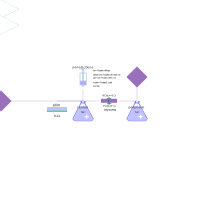
Extends from Pharmacolibrary.Drugs.ATC.N.N02CD05.
Information
| name: | Eptinezumab | |
| ATC code: | N02CD05 | route: | intravenous |
| compartments: | 2 | |
| dosage: | 100 | mg |
| volume of distribution: | 3.7 | L |
| clearance: | 0.17 | L/day |
| other parameters in model implementation | ||
Eptinezumab is a humanized monoclonal antibody that targets calcitonin gene-related peptide (CGRP), which is involved in migraine pathophysiology. It is used as a preventive treatment for migraine in adults and is approved for clinical use.
Pharmacokinetics
Pharmacokinetic parameters obtained from adult healthy volunteers and patients with migraine.
References
Li, XN, et al., & Larsen, F (2023). Pharmacokinetics and Safety of Eptinezumab in Healthy Chinese Participants: A Randomized Clinical Trial. Clinical drug investigation 43(11) 873–881. DOI:10.1007/s40261-023-01315-1 PUBMED:https://pubmed.ncbi.nlm.nih.gov/37917246
Hershey, AD, et al., & Rosen, M (2025). Pharmacokinetics and safety of eptinezumab in children and adolescents with migraine. Headache None –. DOI:10.1111/head.14959 PUBMED:https://pubmed.ncbi.nlm.nih.gov/40444655
Baker, B, et al., & Latham, J (2020). Population pharmacokinetic and exposure-response analysis of eptinezumab in the treatment of episodic and chronic migraine. Pharmacology research & perspectives 8(2) e00567–None. DOI:10.1002/prp2.567 PUBMED:https://pubmed.ncbi.nlm.nih.gov/32155317
Parameters
| Type | Name | Default | Description |
|---|---|---|---|
| Modelica.Units.SI.Mass | weight (from PK_1C) | 75 | patient weight (kg) |
| Modelica.Units.SI.SpecificVolume | VdPerKg (from PK_1C) | 0.9 | Volume of distribution (L/kg) |
| Modelica.Units.SI.MassFraction | F (from PK_1C) | 0.8 | bioavailiability (0-1) |
| Pharmacolibrary.Types.Clearance | Cl (from PK_1C) | 20 | clearance |
| Modelica.Units.SI.Time | adminTime (from PK_1C) | 60 | first administration time (s) |
| Modelica.Units.SI.Time | adminDuration (from PK_1C) | 600 | administration duration (s) |
| Modelica.Units.SI.Time | adminPeriod (from PK_1C) | 8*60*60 | period of administration (default 8 hours)(s) |
| Pharmacolibrary.Types.Mass | adminMass (from PK_1C) | 1000 | administration mass (mg) |
| Integer | adminCount (from PK_1C) | 8 | number of dose administered (1) |
| Pharmacolibrary.Types.Volume | Vd (from PK_1C) | VdPerKg*weight | Volume of distribution (m3) |
| Pharmacolibrary.Types.MassConcentration | Cmin (from PK_1C) | 0.004 | minimal therapeutic range |
| Pharmacolibrary.Types.MassConcentration | Cmax (from PK_1C) | 0.008 | minimal therapeutic range |
| Pharmacolibrary.Types.MassConcentration | Ctox_peak (from PK_1C) | 0.012 | toxicity peak level |
| Pharmacolibrary.Types.MassConcentration | Ctox_trough (from PK_1C) | 0.006 | toxicity trough level |
| Pharmacolibrary.Types.Volume | Vdp (from PK_2C) | VdpPerKg*weight | Volume of distribution (m3) |
| Modelica.Units.SI.SpecificVolume | VdpPerKg (from PK_2C) | 0.9 | Volume of distribution peripheral(l/kg) |
| Pharmacolibrary.Types.Clearance | k12 (from PK_2C) | 1 | intercompartmental C-P clearance |
| Pharmacolibrary.Types.Clearance | k21 (from PK_2C) | 1 | intercompartmental P-C clearance |
Connectors
| Type | Name | Default | Description |
|---|---|---|---|
| Types.ConcentrationOutput | C_central (from PK_1C) | ||
| Interfaces.ConcentrationPort_b | centralCPort (from PK_1C) | ||
| Interfaces.ConcentrationPort_b | peripheralCPort (from PK_2C) | ||
| Pharmacolibrary.Types.ConcentrationOutput | C_peripheral1 (from PK_2C) |
Components
| Type | Name | Default | Description |
|---|---|---|---|
| Pharmacokinetic.NoPerfusedTissueCompartment | central (from PK_1C) | ||
| Pharmacokinetic.ClearanceDrivenElimination | elim (from PK_1C) | ||
| Sources.PeriodicDose | periodicDose (from PK_1C) | ||
| Modelica.Units.SI.Time | t1_2 (from PK_1C) | elimination half-life | |
| Pharmacolibrary.Pharmacokinetic.TransferFirstOrderNonSym | transfer (from PK_2C) | ||
| Pharmacolibrary.Pharmacokinetic.NoPerfusedTissueCompartment | peripheral (from PK_2C) |
Revisions
- 06/2025 Tomas Kulhanek, generated model from data extracted from PUBMED, DrugBank and LLM(GPT4.1)