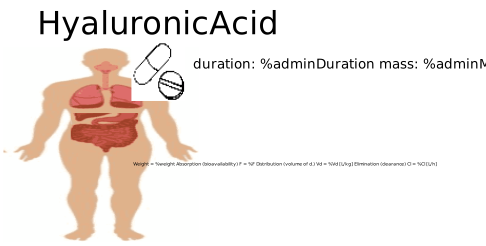
modelHyaluronicAcid
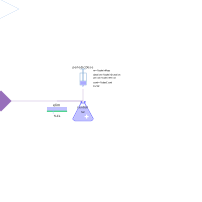
Extends from Pharmacolibrary.Drugs.ATC.S.S01KA01.
Information
| name: | HyaluronicAcid | |
| ATC code: | S01KA01 | route: | ophthalmic |
| compartments: | 1 | |
| dosage: | 2.0 | mg |
| volume of distribution: | 1 | L |
| clearance: | 0 | L/h |
| other parameters in model implementation | ||
Hyaluronic acid is a naturally occurring polysaccharide found in various connective, epithelial, and neural tissues. It is primarily used in ophthalmology as a viscoelastic agent during eye surgery (such as cataract extraction or intraocular lens implantation), and in the treatment of dry eye as ocular lubricants. It is also used in dermatology as a dermal filler and in osteoarthritis for intra-articular injections. Approved products containing hyaluronic acid with ATC code S01KA01 are specifically for ophthalmic use.
Pharmacokinetics
No specific pharmacokinetic studies in humans report detailed compartmental or parameter values for ophthalmic administration of hyaluronic acid. The molecule is known for extremely low systemic absorption and minimal systemic exposure when used via the ocular route.
References
Laffleur, F, & Dachs, S (2015). Development of novel mucoadhesive hyaluronic acid derivate as lubricant for the treatment of dry eye syndrome. Therapeutic delivery 6(10) 1211–1219. DOI:10.4155/tde.15.55 PUBMED:https://pubmed.ncbi.nlm.nih.gov/26606856
López-Machado, A, et al., & Sánchez-López, E (2021). Development of Lactoferrin-Loaded Liposomes for the Management of Dry Eye Disease and Ocular Inflammation. Pharmaceutics 13(10) –. DOI:10.3390/pharmaceutics13101698 PUBMED:https://pubmed.ncbi.nlm.nih.gov/34683990
Labetoulle, M, et al., & Baudouin, C (2017). Osmoprotectants, carboxymethylcellulose and hyaluronic acid multi-ingredient eye drop: a randomised controlled trial in moderate to severe dry eye. Eye (London, England) 31(10) 1409–1416. DOI:10.1038/eye.2017.73 PUBMED:https://pubmed.ncbi.nlm.nih.gov/28452989
Parameters
| Type | Name | Default | Description |
|---|---|---|---|
| Modelica.Units.SI.Mass | weight (from PK_1C) | 75 | patient weight (kg) |
| Modelica.Units.SI.SpecificVolume | VdPerKg (from PK_1C) | 0.9 | Volume of distribution (L/kg) |
| Modelica.Units.SI.MassFraction | F (from PK_1C) | 0.8 | bioavailiability (0-1) |
| Pharmacolibrary.Types.Clearance | Cl (from PK_1C) | 20 | clearance |
| Modelica.Units.SI.Time | adminTime (from PK_1C) | 60 | first administration time (s) |
| Modelica.Units.SI.Time | adminDuration (from PK_1C) | 600 | administration duration (s) |
| Modelica.Units.SI.Time | adminPeriod (from PK_1C) | 8*60*60 | period of administration (default 8 hours)(s) |
| Pharmacolibrary.Types.Mass | adminMass (from PK_1C) | 1000 | administration mass (mg) |
| Integer | adminCount (from PK_1C) | 8 | number of dose administered (1) |
| Pharmacolibrary.Types.Volume | Vd (from PK_1C) | VdPerKg*weight | Volume of distribution (m3) |
| Pharmacolibrary.Types.MassConcentration | Cmin (from PK_1C) | 0.004 | minimal therapeutic range |
| Pharmacolibrary.Types.MassConcentration | Cmax (from PK_1C) | 0.008 | minimal therapeutic range |
| Pharmacolibrary.Types.MassConcentration | Ctox_peak (from PK_1C) | 0.012 | toxicity peak level |
| Pharmacolibrary.Types.MassConcentration | Ctox_trough (from PK_1C) | 0.006 | toxicity trough level |
Connectors
| Type | Name | Default | Description |
|---|---|---|---|
| Types.ConcentrationOutput | C_central (from PK_1C) | ||
| Interfaces.ConcentrationPort_b | centralCPort (from PK_1C) |
Components
| Type | Name | Default | Description |
|---|---|---|---|
| Pharmacokinetic.NoPerfusedTissueCompartment | central (from PK_1C) | ||
| Pharmacokinetic.ClearanceDrivenElimination | elim (from PK_1C) | ||
| Sources.PeriodicDose | periodicDose (from PK_1C) | ||
| Modelica.Units.SI.Time | t1_2 (from PK_1C) | elimination half-life |
Revisions
- 06/2025 Tomas Kulhanek, generated model from data extracted from PUBMED, DrugBank and LLM(GPT4.1)