
packagePharmacokinetic
Extends from Modelica.Icons.Package (Icon for standard packages).
Information
Pharmacokinetic package components can be used to model kinetic and toxicokinetic in terms of absorption, distribution, metabolism, elimination (ADME) of a drug.Compartmental models
For compartmental models use the following connector and components:
| domain | potential variables |
flow variables |
stream variables |
connector definition | icons |
| chemical concentration |
mass concentration | mass flow rate | Pharmacolibrary.Interfaces ConcentrationPort, ConcentrationPort_a, ConcentrationPort_b |
 |
For administration use one of the variants from package Pharmacolibrary.Sources and specify parameters like F (bioavailability) adminMass adminDuration ...
Use _enteral variant if the drug is not administered directly to blood plasma and goes e.g. via enteral way (oral absorption).
For distribution compartment use the basic component: NoPerfusedTissueCompartment and specify parameter Vd (volume of distribution)
If more compartments are in models, they need to be connected via intracompartmental clearance using component TransferFirstOrderNonSym and specify parameters CLa and CLb (intracompartmental clearance from A->B and from B->A
For elimination use the component ClearanceDrivenElimination which is the way eliminated by majority of drugs or compounds and specify the parameter CL (clearance rate).
For other specific use cases see the component documentation.
Physiology based models
Use the following connector and components that takes into account blood flow.
| volumetric flow |
pressure | volume flow rate | mass concentration | Pharmacolibrary.Interfaces FlowPort, FlowPort_a, FlowPort_b |
 |
See component documentation and/or examples for further information.
Majority of drug and compounds can be modeled using 1-compartment, 2-compartment, 3-compartment or PBPK model. E.g. you may inherit generic model from Pharmacokinetics.Models.PK_1C and set drug specific parameters.
Contents
| Name | Description |
|---|---|
 Models Models | |
 NoPerfusedTissueCompartment NoPerfusedTissueCompartment | compartment with no perfusion |
 PeripheralTissueCompartment PeripheralTissueCompartment | compartment including calculation of diffusion transport |
 LumenCompartment LumenCompartment | simplified compartment (lumen) where volume is not considered |
 GenericTissueCompartment GenericTissueCompartment | |
 TissueCompartment TissueCompartment | Tissue compartment |
 SystemicCompartment SystemicCompartment | Systemic compartment |
 FixedFlow FixedFlow | |
 FlowBoundary FlowBoundary | |
 FlowGround FlowGround | |
 ConcBoundary ConcBoundary | |
 SignalConcBoundary SignalConcBoundary | |
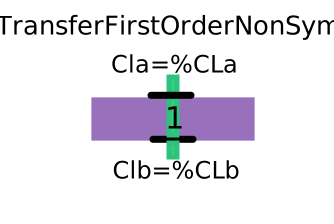 TransferFirstOrderNonSym TransferFirstOrderNonSym | first order non-symetric transfer |
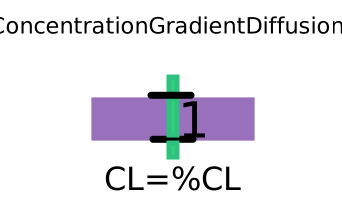 ConcentrationGradientDiffusion ConcentrationGradientDiffusion | first order symetric diffusion transfer |
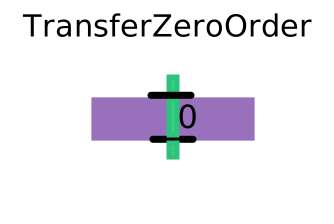 TransferZeroOrder TransferZeroOrder | zero order transfer model |
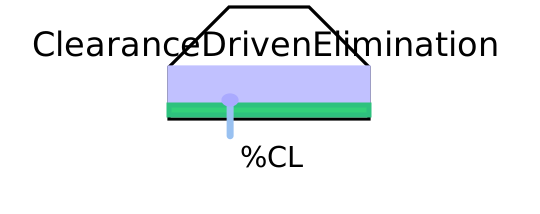 ClearanceDrivenElimination ClearanceDrivenElimination | |
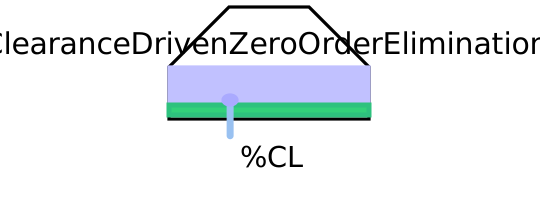 ClearanceDrivenZeroOrderElimination ClearanceDrivenZeroOrderElimination | |
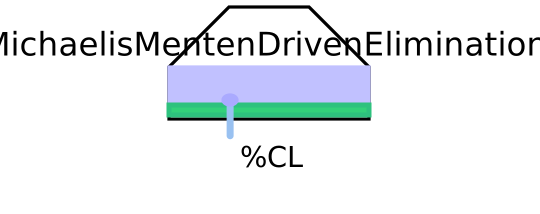 MichaelisMentenDrivenElimination MichaelisMentenDrivenElimination | |
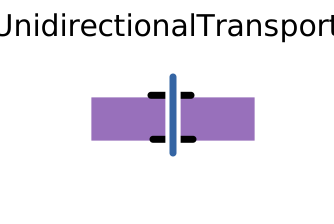 UnidirectionalTransport UnidirectionalTransport | uni-directional first order transport to be used with LumenCompartment as source |
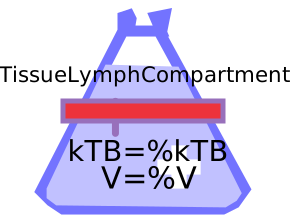 TissueLymphCompartment TissueLymphCompartment | Tissue compartment |
 LymphFlow LymphFlow | |
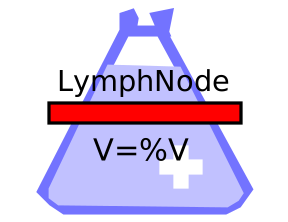 LymphNode LymphNode | Lymph node compartment |